KPop Demon Hunters (2025), the animated film made by Sony Pictures Animation and released on Netflix, became a worldwide phenomenon. Its story of Huntr/x, a K-pop girl group whose members secretly fight demons with song, dance and weapons, is pure modern pop. But underneath the stadium lights, many of its ideas come from very old Korean traditions. This guide looks at the folklore the film draws on, so that you can meet the originals. It describes the film’s basic set-up only and avoids major plot spoilers.
Singing shamans
The film’s central idea, women who protect the world by performing, comes from Korean shamanism. As TIME reported, in the world of the film the demons are kept at bay by K-pop girl groups, and by female shamans before them, for generations. The heroes use song, dance and weapons to slay demons and strengthen the Honmoon, a magical barrier between the world of demons and the world of humans. The Honmoon itself is the film’s invention.
The real figure behind it is the mudang (무당), the Korean shaman, most often a woman, who leads the ritual called gut (굿). A gut is a performance as much as a ceremony, with music, costume changes, dancing and song that can last all night, and its purpose is to invite the gods, honour them and send them away, and to comfort or drive off troubled spirits. An expert in Korean religion told UChicago News that shamans are performers too, but are not really demon hunters: in Korean shamanism, many spirits are simply restless, people who died badly or were never properly mourned, and the shaman’s work is to find a way to put them to rest.
The shaman’s tools are real too. Mudang dance with bells, fans and a spirit knife, sacred objects that belong to the gods they serve.
Read about the mudang and the gut ritual →
Reapers in black hats
The film’s rival boy band, the Saja Boys, are demons in disguise, and their look comes straight from the jeoseung saja (저승사자), the messengers of the Korean underworld who come to collect the souls of the dead. TIME describes the film’s demons as the gat-wearing, hanbok-donning jeoseung saja, and quotes the director Maggie Kang admitting that these figures “terrorized me as a kid”.
The name is a double meaning. Saja can mean “messenger”, as in jeoseung saja, and it is also the Korean word for “lion”, which is why the band’s branding has a lion theme.
Traditional reapers are not glamorous idols. In old shamanic rituals, they appear as rough, grumpy officers who demand money and food, and families set out a meal, straw sandals and coins for them outside the gate. The pale-faced, black-robed, handsome reaper is a much more recent image, made famous by Korean TV dramas.
A goofy tiger and a magpie
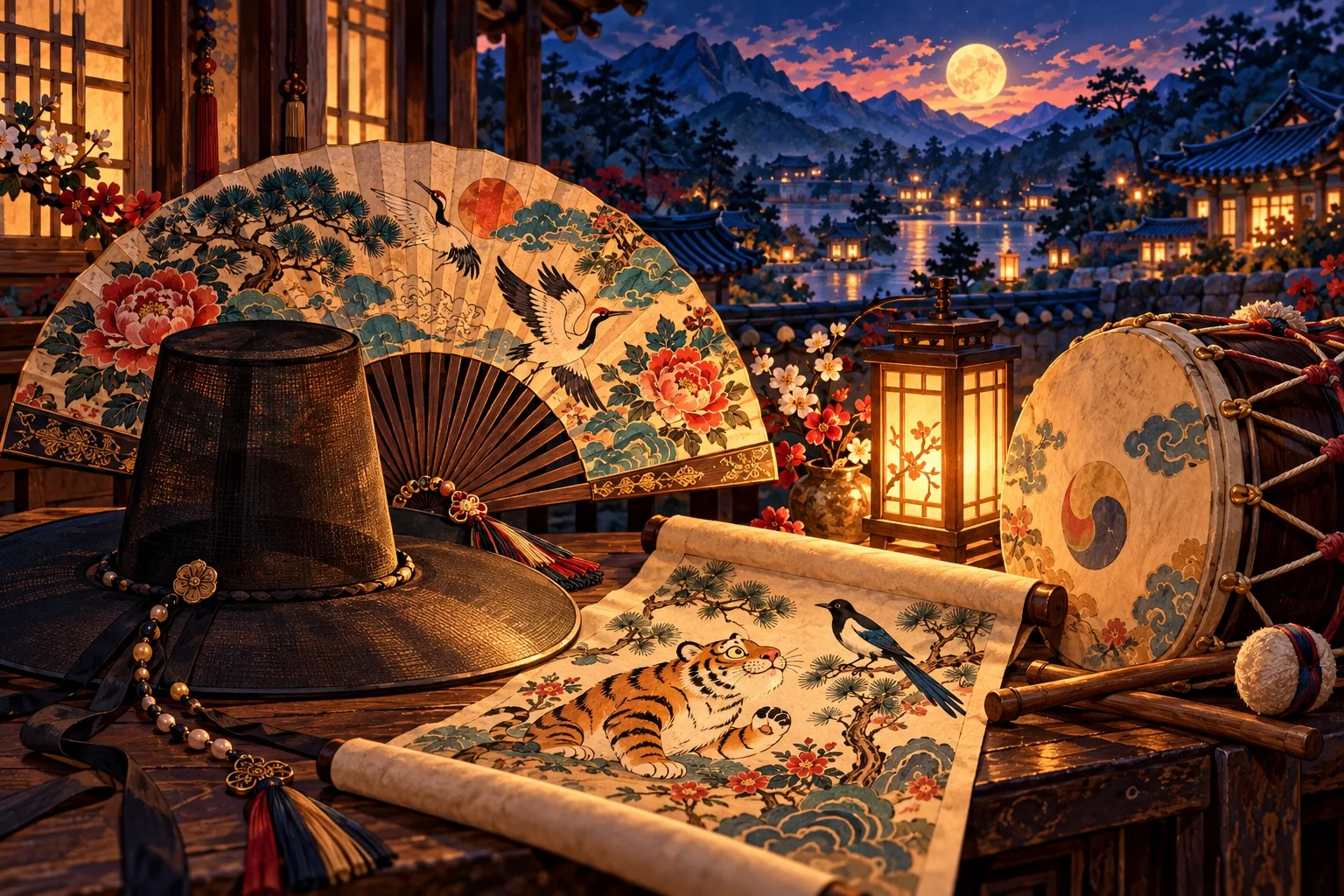
One of the film’s best-loved characters is a big blue tiger with a vacant grin, accompanied by a magpie. Korea.net’s interview with Maggie Kang notes that the tiger, Derpy, was inspired by Korean folk art and the traditional jakhodo, the tiger-and-magpie painting.
In those Joseon-era folk paintings, a tiger sits under a pine, painted with goggling eyes and a foolish expression, while a confident magpie looks down from a branch. The tiger was a guardian against misfortune and the magpie a bringer of good news, and folk painters turned the pair into a gentle joke about the powerful and ordinary people. The film’s goofy tiger and its unimpressed magpie are a direct, affectionate nod to them.
See the tiger and magpie painting →
Demons, ghosts and goblins
The film calls its villains demons, a word with a strongly Christian flavour in English. Korean tradition divides its supernatural beings differently. There are the gwisin, ghosts of people who died with unresolved grief, who are usually pitied as much as feared. There are the dokkaebi, goblins who are as likely to play tricks or give away treasure as to cause harm. And there are the officials of the underworld, whose job is to collect and judge the dead, not to steal souls. When you watch the film, it is fun to notice which traditional ideas have been borrowed and which have been reinvented for a fast, modern action story.
Meet the gwisin → · Meet the dokkaebi →
Real places, real details
The filmmakers also worked hard on everyday details. In the Korea.net interview, Maggie Kang describes visiting Jeju Island, Bukchon Hanok Village in Seoul and the Korean Folk Village to study how roof tiles, brickwork, knotted ropes and braided thatch really look. TIME notes that many Korean viewers appreciated touches such as real Seoul locations, characters speaking Korean, and the tiger and magpie’s roots in Joseon folk painting.
Quick facts
KPop Demon Hunters (2025) blends modern K-pop with traditional Korean folklore. Its singing demon hunters echo the mudang, Korea’s shamans, whose gut rituals use music and dance to deal with spirits. Its demon boy band, the Saja Boys, borrow the black hats and robes of the jeoseung saja, the underworld’s messengers, and their name puns on “messenger” and “lion”. Its goofy tiger and magpie come from the jakhodo folk painting. The Honmoon barrier is the film’s own invention.
Explore the Korean collection →
Sources & further reading
- TIME · How KPop Demon Hunters Conquered the World (2025) ↗
- Korea.net · Interview with KPop Demon Hunters creator Maggie Kang (2025) ↗
- UChicago News · Souls, fandom and KPop Demon Hunters (2025) ↗
- Encyclopedia of Korean Culture · 무당 (mudang) ↗
- Encyclopedia of Korean Culture · 저승사자 (jeoseung saja) ↗
- Encyclopedia of Korean Culture · 까치호랑이 그림 (the tiger and magpie painting) ↗