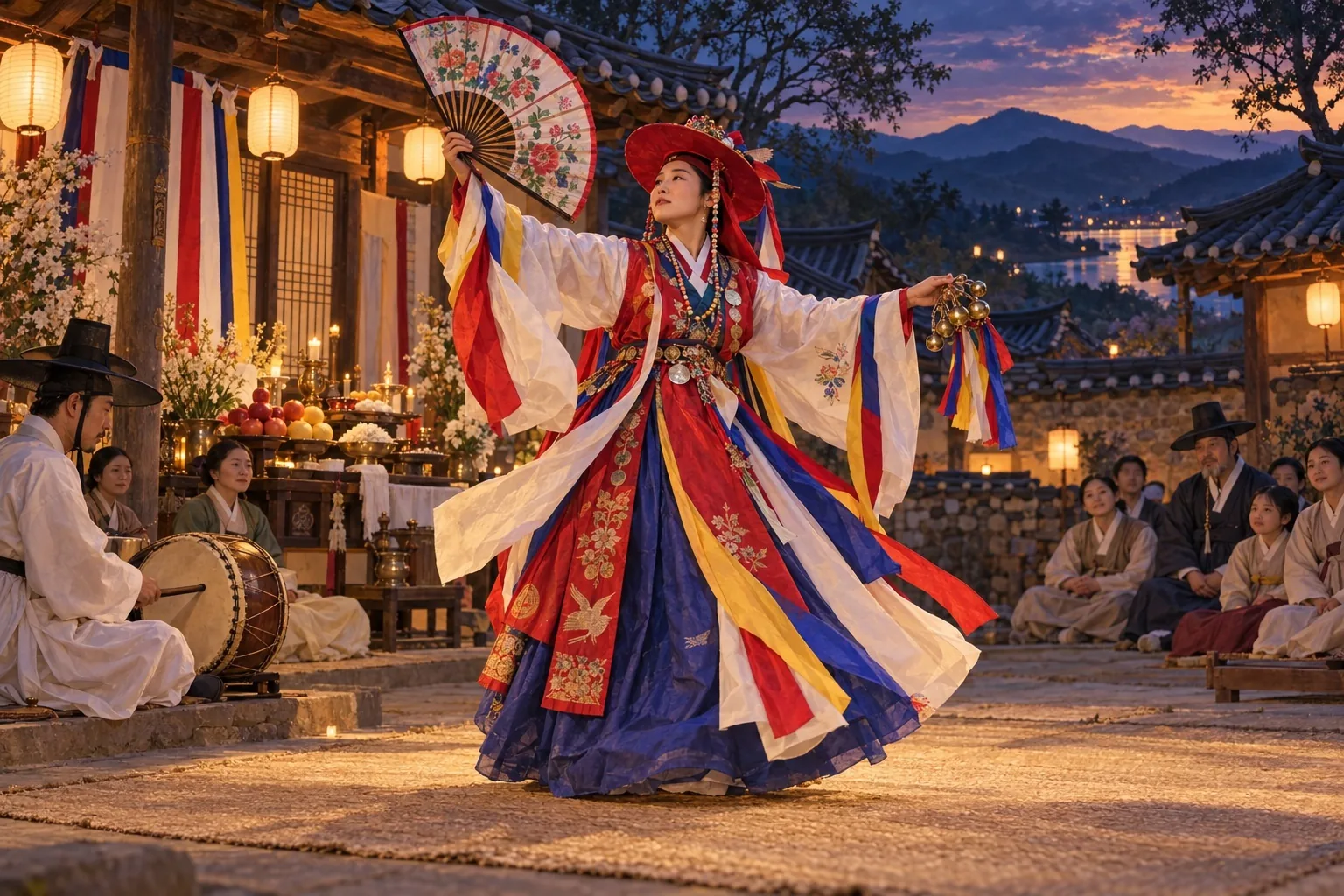
Almost every creature and spirit on this site leads back, sooner or later, to one figure: the mudang (무당), the Korean shaman. When a ghost needed comforting, a newborn needed protecting, a fishing fleet needed a safe season or a village needed a good harvest, people called a mudang. With drums, cymbals, songs and dancing that could last all night, the mudang invited the gods into the human world, gave them food and honour, carried people’s wishes to them, and then politely sent them home again. That ceremony is called a gut (굿), and it is one of the oldest living traditions in Korea.
Who is a mudang?
The Encyclopedia of Korean Culture describes the mudang as a religious specialist who serves the gods and leads gut rituals. Mudang have many regional names. In Honam, in the southwest, they are often called dangol, and on Jeju Island simbang. A male shaman is called a baksu. Most mudang have traditionally been women.
The mudang’s role is to stand between two worlds. During a ritual, the encyclopedia explains, the shaman enters a state of ecstasy, makes contact with the gods and passes on their words, acting as a medium who tells the gods what people hope for and tells people what the gods want. The god’s spoken message, delivered in the shaman’s own voice, is called gongsu.
The tradition goes back to Korea’s earliest kingdoms, when spiritual and political leadership were not yet separate. The encyclopedia notes that the second king of Silla, Namhae, was given the title chachaung, which the old histories say meant “shaman” in the local language, and that he had his younger sister Aro lead the rites at the shrine of the kingdom’s founder. A shaman also appears in the records of Goguryeo, discovering the cause of King Yuri’s illness and curing it.
Two ways to become a shaman
Korean tradition recognises two main kinds of mudang, and they become shamans in completely different ways.
The first are gangsinmu, “shamans possessed by a spirit”, found mostly in central and northern Korea, including Seoul. Their path begins with something they do not choose: sinbyeong, the spirit illness. According to the encyclopedia, the future shaman falls mysteriously ill, stops eating, grows thin, suffers pains that move around the body and has vivid dreams in which gods appear and give instructions. The illness can last for years, and medicine does not help. It is believed to end only when the person accepts the spirit through an initiation ritual called naerimgut. After that, the new shaman trains for about three years under the mudang who performed the initiation, now called their sineomeoni, “spirit mother”, and the student becomes a spirit daughter or spirit son.
The second are seseummu, hereditary shamans, found mostly in the south, along the east coast and on Jeju. They do not go through spirit possession. Instead, the right to lead rituals passes down through families. In Honam, the encyclopedia explains, each family of dangol traditionally held its own territory of client households, and a woman usually became a shaman by marrying into a shaman family and learning the rituals from her mother-in-law.
The difference shows in the ritual itself. In the north, the shaman becomes the god during the gut: the face, gestures and voice belong to the deity. In the south, the shaman stays human, facing the gods and singing to them on the people’s behalf. Jeju’s simbang sit somewhere in between, asking the gods’ will through ritual tools that are thrown and read.
What happens at a gut?
The encyclopedia gives a gut’s basic shape in three movements: inviting the gods, entertaining them and making wishes, and sending them away. A large gut is made of twelve to thirty smaller episodes called geori, and each geori follows the same pattern. The ritual space is purified first and the gods invited. The middle episodes welcome and honour the important gods one by one. At the very end, the shaman feeds the wandering, nameless spirits, so that none leave hungry or offended.
The look and sound of a gut vary across Korea. In Seoul and the region north of the Han River, shamans wear splendid robes, perhaps influenced by palace dress, changing costume for each god, sometimes twelve to twenty times in one ritual, and dance to the hourglass drum janggu, gong, cymbals, fiddle and pipes. In Hwanghae province, gut are dramatic and theatrical, with vigorous sword dances. In the south, the music is slower and gentler, with zithers among the instruments, and shamans often wear simple white clothes. The tools in the shaman’s hands, such as bells, a spirit knife and a folding fan, are not props but sacred objects belonging to the gods.
A smaller, quieter rite also exists. Bison is a simple prayer offered by a single shaman, sitting rather than dancing, with modest offerings.
A gut for every need
The encyclopedia sorts gut into three broad groups. Some are the shaman’s own rituals: the initiation and the seasonal rites that renew a shaman’s connection with their gods. Some are held by families. And some are held by whole villages.
Family gut cover the whole of life. There are rites asking Samsin, the goddess of birth, for a child and for a healthy baby; rites to cure illness, including smallpox, which was personified as a demanding spirit; a rite before a wedding; a rite for a new house, honouring the house god Seongju; rites for good fortune and for the safety of fishermen, offered to the Dragon King. When someone died, a gut guided their soul safely to the next world. The jinogwi gut of Seoul and the ssitgim gut of the southwest, which “washes” the soul clean, are among the best known, and a special rite exists to recover the souls of people who drowned.
Village gut, held in spring or autumn for the guardian god of the community, kept away misfortune and asked for a good harvest inland or a good catch on the coast. You will meet several of the gods honoured at gut elsewhere on this site, from the mountain god to the goddess who brings babies.
Meet Samsin Halmeoni, the goddess of birth →
An ancient tradition
How old is the gut? Written records are scarce. The thirteenth-century writer Yi Gyu-bo left a long poem called “The Old Shaman” describing a shaman possessed by a god, delivering gongsu and leaping in dance, a scene the encyclopedia says closely matches gut in central Korea today, so the ritual’s basic form was in place by the Goryeo period at the latest. Ritual bells found by archaeologists resemble the bells shamans still shake, which suggests the roots go back much further.
Over the centuries, Confucian scholars, governments and modernisers often looked down on shamans, and the encyclopedia notes that today many mudang work quietly, out of public view. Yet gut never disappeared. Several great regional rituals are now protected as national intangible heritage, and Korean film and television return again and again to the figure of the shaman who can speak to the dead.
Quick facts
A mudang is a Korean shaman who serves the gods and leads gut rituals. Some become shamans after a spirit illness and an initiation, mostly in central and northern Korea. Others inherit the role through their families, mostly in the south and on Jeju. A gut invites the gods, honours them and sends them away again, through many episodes of song, music and dance. Gut were held for births, healing, new houses, fishing, the dead and whole villages, and the tradition reaches back at least to the Goryeo period.
Meet the gwisin, the ghosts that gut help to comfort →