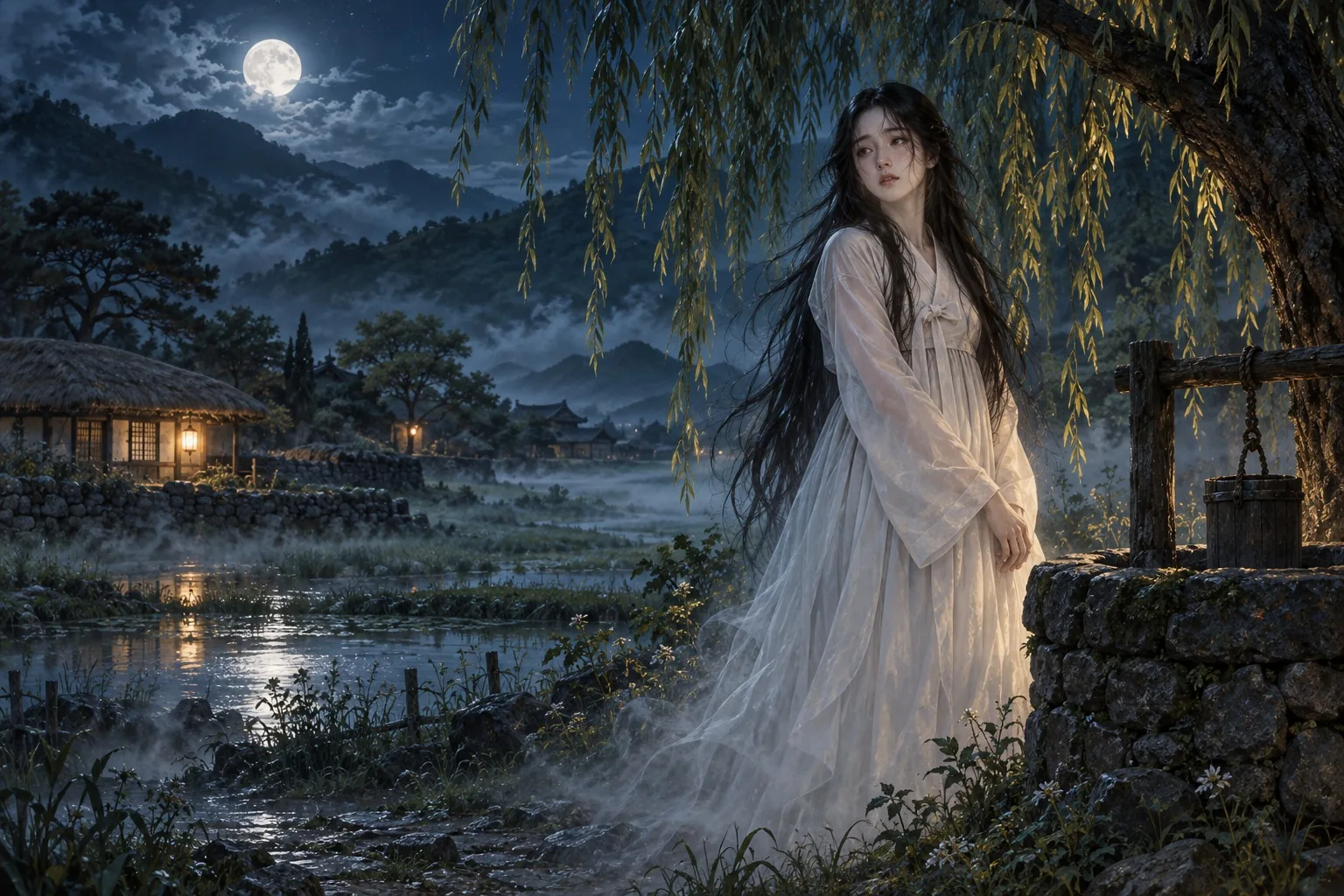
Picture a Korean ghost and you probably imagine the same figure that appears in countless films and late-night TV dramas: a young woman in a long white dress, her black hair hanging loose over her face, standing silently at the end of a corridor or beside a well. That image is not an invention of horror movies. She is the cheonyeo gwisin, the maiden ghost, and she sits at the centre of a very old and very particular Korean idea about why the dead sometimes refuse to leave.
The Korean word for ghost is gwisin (귀신), and this guide explains what it means, which ghosts were feared most, and why, in Korean tradition, a ghost is almost always someone who was cheated of something in life.
What is a gwisin?
In its broadest sense, gwisin refers to any being with supernatural power. The Encyclopedia of Korean Culture explains that the word has covered two main groups over the centuries: spirits of nature and the cosmos, and the souls of the dead. When Koreans talk about ghosts today, they mean the second group, and especially the restless ones.
The key to understanding Korean ghosts is the idea of a “good death”. According to the encyclopedia, a person was expected to pass peacefully into the next world if three things were true. They had lived a full life and died naturally at home, rather than suddenly or violently. They belonged somewhere, with family and community ties. And their identity was clear, with a known name and place in society. Someone who died like that became a respected ancestor, remembered by descendants in the memorial rites called jesa, and was thought to bless the family in return.
Someone who died without those things was in danger of becoming a wongwi (원귀), a resentful ghost, stuck between the world of the living and the underworld. These are the gwisin of Korean ghost stories. What keeps them here is han (한), a deep, unresolved grief and sense of injustice that is one of the most important emotional ideas in Korean culture.
The maiden ghost
The most feared of all Korean ghosts was the spirit of a young woman who died unmarried. She has several names: cheonyeo gwisin (maiden ghost), songaksi (손각시), sonmalmyeong (손말명) and, in one especially dangerous form, wangsin (왕신).
In traditional Korea, marriage was what turned a girl into a full adult member of society. A young woman who died before she could marry had, in this way of thinking, been denied her whole life, and her han was correspondingly fierce. The early twentieth-century scholar Yi Neung-hwa wrote that among all resentful ghosts in Korea, the songaksi was said to be the most frightening. Folk belief held that she haunted girls of the age she had been when she died, bringing them illness or stopping them from finding a husband, and that a wangsin could bring ruin on an entire household.
Families went to great lengths to prevent a daughter from becoming such a ghost. The Encyclopedia of Korean Culture records some striking customs. An unmarried girl might be buried dressed in men’s clothes, or secretly buried beneath a busy crossroads, so that men would walk over her grave and her longing would be eased. In Gangwon province, a ritual called heojaebi gut was performed to marry unmarried young people to each other after death. In some homes, a wangsin was treated as a household spirit and given a small jar or box on a shelf, and the family offered it the first share of anything new that came into the house.
Bachelor ghosts and the wandering dead
Young men who died unmarried could become ghosts too. They were called mongdal gwisin (몽달귀신), the bachelor ghost, and the old incantations that parents recited to drive off sickness often name both in a single breath: “bachelor ghost who died unwed, maiden ghost who died unwed”.
Beyond them was a whole crowd of the restless dead. The encyclopedia lists ghosts of people who died in war or in fights, at the hands of pirates or bandits, from hunger or disease, in collapsing buildings, from animal attacks, by unjust execution or in childbirth. There were ghosts of the drowned and ghosts of those who died in fires, ghosts of children and ghosts of strangers who died far from home with nobody to bury them. Korean tradition calls these lonely, nameless dead mujugohon (무주고혼), souls with no one to care for them. Because nobody held memorial rites in their name, they wandered hungry and could bring misfortune on the living.
How Koreans dealt with ghosts
There were two main ways to deal with a troublesome ghost: comfort it or drive it away.
Comforting came first. Shamans performed rituals called gut in which the spirits of the dead were invited to speak, express their grievances and receive food and honour, so that their han could be released and they could move on. Whole villages held rites for the spirits of their area, and the Joseon state itself held official sacrifices, called yeoje, for the hungry and forgotten dead, to stop them from causing epidemics and disasters. Interestingly, some famous figures who died tragic or unjust deaths, such as King Gongmin of Goryeo, the general Choe Yeong and Crown Prince Sado, ended up being worshipped as powerful guardian gods in shamanic ritual, rather than remaining dangerous ghosts.
When comfort failed, there were ways to fight back. Korean tradition used fire, sulphur, knives, blood, red beans, red earth, peach-wood branches, clean water, salt, scriptures and written talismans, bujeok, against harmful ghosts. Some ritual specialists who chanted scripture were said to trap ghosts in bottles or wooden casks and bury them deep in the ground.
Ghosts in Korean stories
Korean ghost stories are often less about terror than about justice. In the classic Joseon tale Janghwa and Hongryeon, two sisters killed through their stepmother’s schemes appear as ghosts before the local magistrate, and each new official dies of fright, until finally a brave one listens to them and sets things right. The legend of Arang, a young woman murdered in Miryang, follows the same pattern: the ghost does not want revenge so much as to be heard. In both, the frightening figure in white turns out to be a victim asking for her story to be told.
That idea still shapes Korean horror today, in films such as A Tale of Two Sisters (2003), loosely based on Janghwa and Hongryeon, and in television’s long-running tradition of ghost dramas. The ghost is scary, but the real horror is usually what was done to her.
Quick facts
Gwisin are the ghosts of Korean tradition. A person who died a full, natural death among family became an honoured ancestor, but someone who died young, violently, far from home or unrecognised might become a resentful ghost, held in this world by han. The most feared was the maiden ghost, or songaksi, of a girl who died unmarried. Ghosts were comforted with shamanic rituals and state rites, or driven away with salt, red beans, peach wood and talismans.
Meet the jeoseung saja, the Korean grim reaper →