Deep under the South Sea, in a palace of coral and pearls, the Dragon King fell gravely ill. He lay on his great bed of seaweed, groaning, his scales grey and dull, and nothing anyone did could make him better.
His doctors tried every medicine in the ocean. They brought him powdered pearl and sea-cucumber soup, rare weeds from the deepest trenches and the ink of ancient octopuses. Nothing worked. The king grew weaker by the day.
At last an old physician, who had come from far away, examined him for a long time and then shook his head.
“Your Majesty,” he said, “there is only one cure left in all the world. You must eat the fresh liver of a rabbit.”
The whole court looked at one another. A rabbit? Rabbits lived on land, high up in the mountains, where no fish could swim. None of the king’s subjects had ever seen one. Most of them were not even sure what a rabbit looked like.
Who will go?
The Dragon King called all his ministers together in the great hall.
“Which of you,” he whispered from his bed, “will go up to the land and bring me back a rabbit?”
There was a long, uncomfortable silence.
The whale said he was far too big to crawl up onto a beach. The octopus said his skin would dry out in the sun. The flatfish said he could not see properly out of water, and besides, both his eyes were on the same side of his head. The crab said he was terribly sorry, but he could only walk sideways and would never get there. One by one, every grand minister of the sea found an excuse.
Then a small voice spoke up from the back of the hall. It was a soft-shelled turtle, a loyal and rather unimportant official called Byeoljubu.
“Your Majesty,” he said, “I can live in the water and on land. I will go.”
The king wept with gratitude. The court painter drew a picture of a rabbit from an old description, with long ears and a short tail and round red eyes, so that the turtle would know one when he saw it. Byeoljubu tucked the picture under his shell, swam up and up through the water until he broke through the waves into the sunlight, and crawled slowly out onto the beach.
The rabbit on the hill
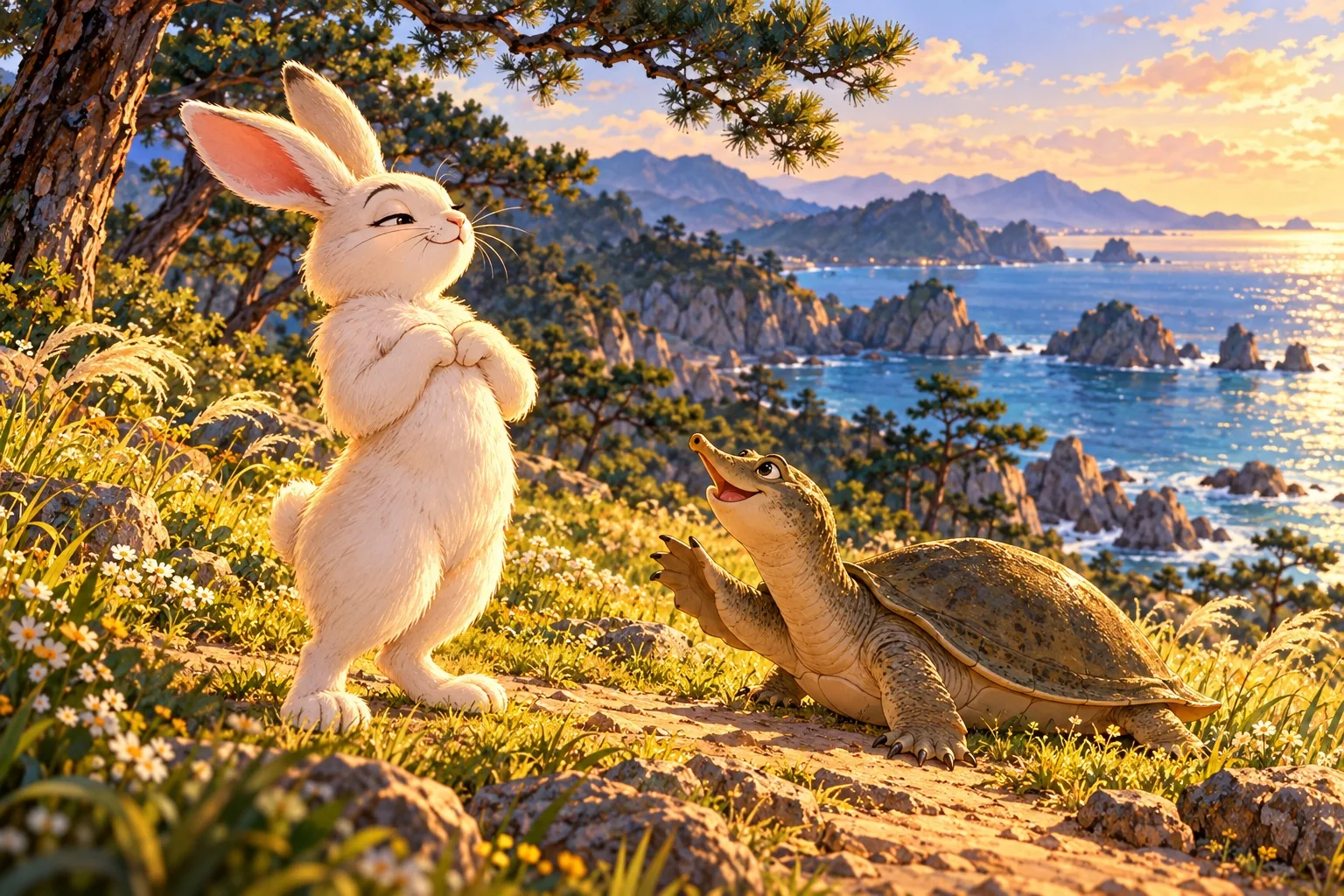
The turtle climbed for a long time, up from the beach and into the green hills. He passed deer and squirrels and pheasants, checking each against his picture. Then, in a sunny meadow near the top of a mountain, he saw a creature lazing in the grass, with long ears and a short tail and round red eyes. He looked at the picture. He looked at the creature. It was a rabbit.
The turtle bowed low. “Good day, sir,” he said. “What a fine, handsome creature you are. I have travelled all over the world, and I have never seen such elegant ears.”
The rabbit sat up, very pleased. Nobody had ever praised his ears before.
“But life up here must be hard for someone like you,” the turtle went on, shaking his head sadly. “Hunters with their dogs. Hawks and eagles diving out of the sky. Long, cold winters with nothing to eat but bark. It is a shame to see a creature of your quality living like this.”
The rabbit had to admit that this was true. Only last week a hawk had nearly caught him.
“Now, under the sea,” said the turtle, lowering his voice, “the Dragon King is looking for talented people to serve at his court. A rabbit like you would be given a high post straight away. You would have a palace of your own, servants to wait on you, and all the food you could eat. No hunters. No hawks. No winter.”
The rabbit had never been offered anything like it. His whiskers twitched. He thought about the hawk, and the cold, and the bark. Then he climbed onto the turtle’s back, and down the hill they went, and into the waves, and down into the sea.
In the palace under the sea
When they reached the coral palace, the rabbit stared about him in wonder at the pearl-studded walls and the shining halls. Then the guards rushed forward, seized him and tied him up with ropes of seaweed.
They dragged him before the Dragon King, who raised himself on his bed and looked at the rabbit with feverish eyes.
“Welcome, rabbit,” said the king, quite politely. “I am sorry about the ropes. You see, I am very ill, and the only thing that can save me is your liver. You should feel honoured. It is not every day that a rabbit gets to save a king.”
The rabbit’s blood ran cold. He realised at once that he had been tricked, and that the turtle’s fine words had been nothing but bait. For a moment he could not breathe. Then he made himself breathe, and he made himself think, very fast.
“Your Majesty,” he said, and he even managed to smile, “I would be delighted to give you my liver. Truly, it would be the greatest honour of my life. But I’m afraid I don’t have it with me.”
The king frowned. “What do you mean, you don’t have it with you?”
“Well,” said the rabbit, “we rabbits are famous for our magic livers. Everyone wants them, as you know yourself. So to keep them safe, we take them out and hide them in the mountains. In fact, I washed mine in a stream only this morning and left it on a rock to dry in the sun. If your turtle had only told me why I was coming, I would have brought it with me.”
The king looked at the turtle. The turtle looked at the floor.
“Look,” said the rabbit, “I can prove it.” And he pointed out that rabbits have three holes underneath, one for eating, one for breathing, and one for taking out the liver. The courtiers peered and murmured. It certainly looked convincing.
Back to the shore
The Dragon King believed every word. He ordered the ropes taken off at once and apologised for the misunderstanding. He threw a great feast in the rabbit’s honour, with music and dancing fish, and the rabbit ate and drank and bowed to everyone. Then the king sent him back to land on the turtle’s back to fetch his liver.
The moment they reached the shore, the rabbit leapt off the turtle’s back and scampered up the beach. At the top of the first hill he turned round.
“You fools!” he shouted, laughing. “Who in the world has ever heard of an animal taking out its own liver?”
And he vanished into the trees.

The turtle sat on the sand for a long time. He could not face going back to the palace empty-handed. In some versions he weeps on the shore until a mountain spirit takes pity on his loyalty and gives him a magic medicine for the king. In others he simply goes home in shame. The rabbit, of course, lives happily ever after, at least until his next adventure.
The waves washed over his shell. Gulls laughed overhead. He thought of his king lying sick in the coral palace, and of all the grand ministers who had refused to come, and of how he alone had volunteered, and tears ran down his leathery cheeks.
Talk about it
Was the rabbit wrong to lie? Who is the real villain here, the Dragon King, the turtle or nobody? And why do you think a royal official in 642 told this story to a prisoner?
Words to know
Tokki (토끼) means rabbit. Jara (자라) is the soft-shelled turtle; Byeoljubu is the turtle’s official title in the story. Yongwang (용왕) is the Dragon King, ruler of the sea in Korean folk belief.
Where this story comes from
The oldest Korean version is in the Samguk Sagi (삼국사기, History of the Three Kingdoms), compiled by Kim Busik in 1145. In the biography of the general Kim Yu-sin, the Silla statesman Kim Chunchu, who later became King Taejong Muyeol, is held prisoner in the rival kingdom of Goguryeo in 642. An official named Seon Do-hae quietly tells him the tale of the turtle and the rabbit. Kim Chunchu takes the hint, promises his captors something he has no intention of giving, and is released, just as the rabbit was. This short version is known as the Gutoji seol (구토지설), "the tale of the turtle and the rabbit".
The tale itself is older still. Scholars trace it back to the Buddhist Jataka stories from India, where a monkey tricks a crocodile in almost exactly the same way by claiming to have left its heart in a tree. The story seems to have travelled to Korea with Buddhism.
In the late Joseon period, the tale grew into the novel Tokki-jeon or Byeoljubu-jeon and the pansori song Sugung-ga (수궁가, "Song of the Underwater Palace"), one of the five classic pansori still performed today. These longer versions are packed with comedy, satire and long speeches, especially from the cowardly sea creatures who refuse to go to land.
What it means
At its simplest, this is a story about using your head. The rabbit is weaker than everyone around him, but he survives because he stays calm and tells a lie that is bold enough to work. It's also a warning about flattery: the rabbit only gets into trouble because he believes the turtle's talk about fine palaces and important jobs.
The pansori and novel versions add sharp social satire. The Dragon King is a ruler who is ready to kill an innocent creature for his own health, and his ministers are mostly useless. Many scholars read it as a joke at the expense of the Joseon ruling class. The turtle is the most interesting character of all, since he is loyal, brave and honest, and he still ends up the loser.
Sources & further reading
Samguk Sagi, Biography of Kim Yu-sin (the turtle and rabbit tale told to Kim Chunchu); the novel Tokki-jeon and pansori Sugung-ga, following the Encyclopedia of Korean Culture (encykorea.aks.ac.kr) entries "토끼전" and "구토지설".
- Samguk Sagi (1145) · Biography of Kim Yu-sin, the tale told to Kim Chunchu
- Encyclopedia of Korean Culture · 토끼전 and 구토지설
Illustrations are imaginative interpretations, not historical records. Read our editorial policy.