Long ago, in a village in the south of Korea, there lived two brothers who could not have been more different. The elder, Nolbu, was broad, loud and greedy right down to his bones. The younger, Heungbu, was thin, gentle and so kind that the villagers joked he would give away his own shadow if someone asked for it. While their father was alive, the two lived under the same roof. But when the old man died, Nolbu took the house, the rice fields, the storehouse and every last coin for himself.
The old storytellers loved listing Nolbu’s nasty habits, and the list was long. He kicked over the pots of people who were cooking, poked holes in the bottoms of neighbours’ water jars and trampled young rice plants in other people’s paddies just to watch them droop. He would pull a child’s hair as he walked by and argue with a beggar over a single grain of rice. Soon he decided that feeding his younger brother was a waste. One cold morning he stood in the gate and shouted, “I’ve kept you long enough! Take your wife and your brats and get out!” Heungbu, his wife and their crowd of hungry children left with nothing but the clothes they wore.
Heungbu gathered sticks and straw and built a hut on the edge of the village. It was so small that when he lay down to sleep, his feet stuck out of the doorway and his head pushed against the back wall. When it rained, water dripped through the roof onto the children. Heungbu took any work he could find. He carried loads, chopped wood, fetched water and helped with other people’s harvests, but it was never enough to fill all those mouths. In some tellings he even went to the county office to take a beating in a rich man’s place, because the rich man would pay someone else to be flogged for him. Heungbu came home bruised and with less money than he had been promised.
One day, when the children had not eaten for three days, Heungbu swallowed his pride and walked to his brother’s house to beg for a bowl of rice. Nolbu would not even look at him. He grabbed a stick and chased Heungbu out of the courtyard. As Heungbu stumbled past the kitchen, Nolbu’s wife came out holding the big wooden rice paddle, still sticky from the pot, and slapped him across the face with it. A few grains of rice stuck to his cheek. Heungbu was so hungry that he picked them off and ate them, and then, with a sad little smile, he turned the other cheek and asked her to hit him there too, so he could take a few more grains home.
When spring came, a pair of swallows flew in and built a mud nest under the eaves of Heungbu’s hut. The children loved them. They watched the parents dart in and out all day and counted the tiny beaks that poked over the edge of the nest. One afternoon a big snake slid up the wall toward the nest. The family shouted and chased it off, but in the commotion one chick toppled out and fell to the ground. Its little leg was broken. Heungbu picked it up as gently as he could. He found a scrap of fabric and a bit of thread, set the leg straight, bound it carefully and put the chick back in the nest. Every day he checked on it, and slowly the leg healed. By autumn the young swallow could fly with the others, and when the cold winds started, the whole flock left for the warm south, to the faraway land the old stories call Gangnam.
Heungbu’s wife said a swallow’s nest was good luck, and for once, nobody in the family could argue with her. Every morning the children woke to the sound of twittering above the door, and every evening they lay in a row on the floor and listened to the birds settle down for the night.

The next spring, the swallow came back. It circled Heungbu’s hut, landed in front of him and dropped something at his feet. It was a single gourd seed. Heungbu didn’t know what else to do with it, so he planted it by the wall of the hut. The vine shot up faster than anything he had ever grown. It climbed the wall and spread across the straw roof, and by autumn it carried several enormous gourds, round and pale and so heavy that the roof sagged beneath them.
Heungbu was mending the fence when he heard a familiar twitter. He looked up and saw a swallow with a slight crook in one leg, flying lower and lower over the yard, and he called to the children to come and look.
There was still nothing to eat in the house. Heungbu and his wife decided to cut one of the gourds open, cook its soft flesh in a soup and dry the shell to sell as a bowl. They sat on either side of it with a long two-man saw and started to cut, singing a sawing song to keep the rhythm, seulgeun seulgeun, back and forth, back and forth. The gourd split open, and out poured rice, more rice than they had seen in years, followed by coins that rolled across the yard in shining heaps. The children screamed with delight.
They sawed open the second gourd, and out came bolts of fine silk, jewellery and treasures. From the third came a whole crew of carpenters with their tools, who set to work at once and built a grand house with a tiled roof, a storehouse and a gate, all before sunset. By evening, the poorest family in the village had become the richest.
News like that travels fast, and it soon reached Nolbu. He marched over, saw the new house with his own eyes and demanded to know how it had happened. Heungbu, honest as ever, told him the whole story. Nolbu went home with a plan. He waited until spring, climbed up to a swallow’s nest, grabbed a chick and snapped its leg himself. Then he bandaged it with great ceremony, feeling very pleased with his own cleverness, and put it back.
All winter he could hardly sleep for thinking about it. He went out every morning to stare at the empty eaves of his house and grumble at the sky, waiting for the swallows to come back.
In autumn his swallow flew south, and the next spring it returned and dropped a gourd seed at Nolbu’s feet. Nolbu planted it, and the vine grew just as fast as his brother’s. When the gourds were ripe, he called his wife, picked up the saw and started on the biggest one, already counting his gold.
The first gourd split open, and out came a crowd of beggars and moneylenders waving old debts, who would not leave until Nolbu had paid them. The second was packed with travelling entertainers, acrobats and fortune-tellers, all demanding their fee. Nolbu kept sawing, sure that the treasure had to be in the next one. Out of another burst a gang of goblins who beat him black and blue. When he opened the last gourd, a flood of filthy muck gushed out, filled the yard, poured into the house and buried everything he owned.
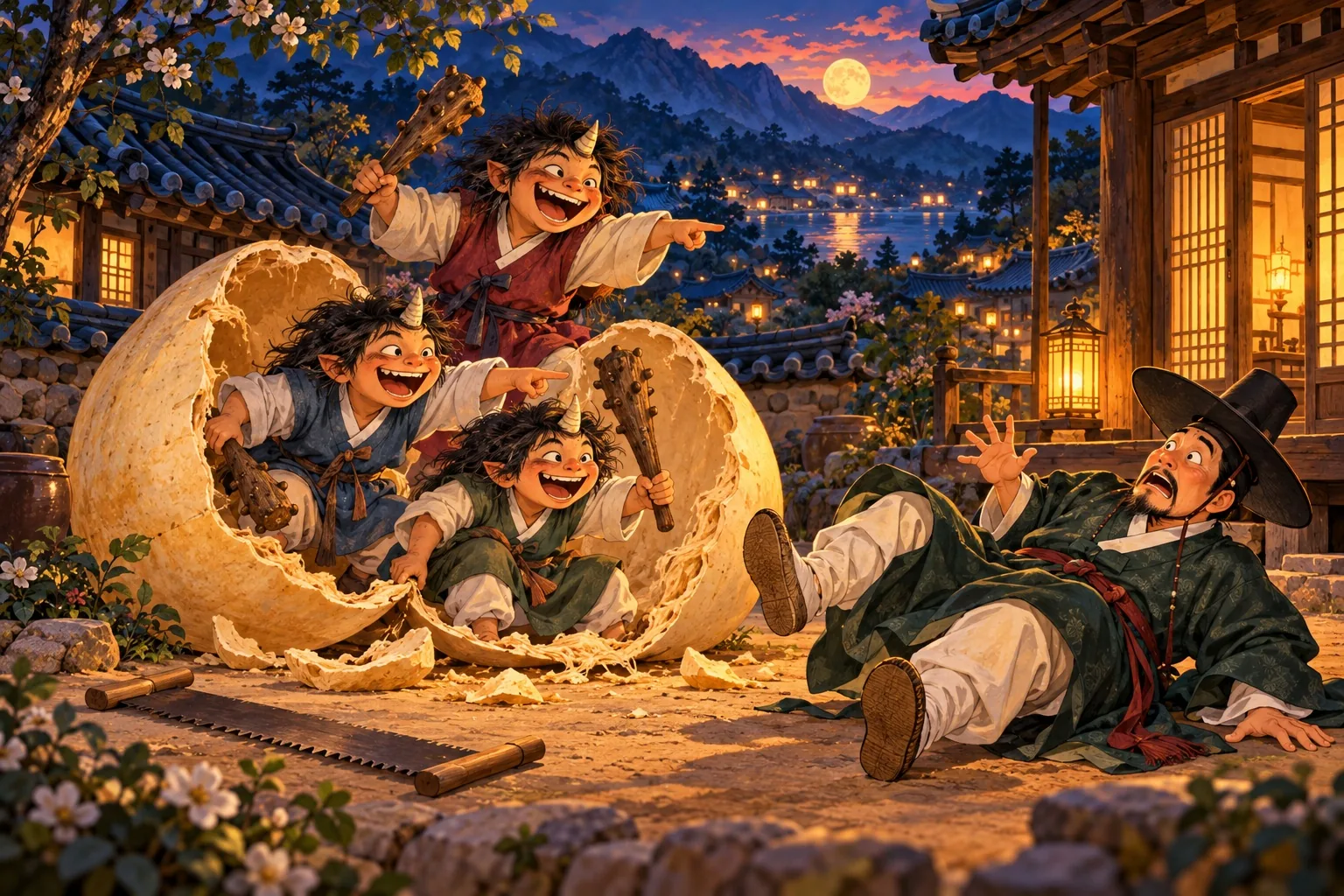
Nolbu and his wife were left with nothing. With nowhere else to go, they shuffled to Heungbu’s gate in rags, too ashamed to look up. Heungbu didn’t hesitate for a second. He ran out, threw his arms around his brother and brought him inside. He gave him clothes, a room and a share of everything he had. Nolbu, who had never been treated kindly by anyone because he had never been kind to anyone, wept with shame and promised to change. From that day on, the two brothers lived side by side in peace.
Talk about it
Why does the swallow reward Heungbu and punish Nolbu, when both of them bandaged its leg? Was Heungbu right to forgive his brother after everything he did? And is there a “Nolbu” character in a modern film or show you know?
Words to know
Bak (박) is a large round gourd that was traditionally dried and cut in half to make bowls called bagaji. Jebi (제비) means swallow. Pansori (판소리) is a traditional form of Korean musical storytelling.
Where this story comes from
Heungbu and Nolbu is best known through two classic forms from the late Joseon period (roughly the 18th and 19th centuries). One is the pansori song Heungbo-ga (흥보가), a long sung performance by a single singer with a drummer, which is still performed today as one of the five surviving classic pansori. The other is the novel Heungbu-jeon (흥부전), which exists in many handwritten and woodblock editions. The details, the jokes and even the brothers' names vary between versions, and the pansori singers added countless comic scenes over the years.
The story's roots go back much further. A tale known as the Bangi legend (방이 설화), about two Silla brothers, one kind and one greedy, who are rewarded and punished by a magical object, was written down in the 9th-century Chinese collection Youyang Zazu. Folklorists also point to similar "kind and greedy brother" stories with grateful birds across Mongolia, China and Japan, where the Japanese tale of the tongue-cut sparrow follows a very similar pattern. An early English version was published by Horace Allen in Korean Tales (1889).
What it means
At first glance this is a simple story about being nice. Heungbu helps a hurt animal and is rewarded, while Nolbu pretends to help and is punished. The key detail is that Nolbu does exactly the same thing as Heungbu, bandaging a swallow's leg, but he does it for the wrong reason and only after hurting the bird himself. The story is clear that kindness only counts when it is real.
It also makes fun of greed in a way that people in Joseon society would have recognised. Nolbu is a rich landowner who hoards everything, and the things that pour out of his gourds, from beggars to moneylenders to angry performers, are all people demanding the money he refused to share. Some scholars read the story as a comment on the growing gap between rich and poor in the late Joseon period. Heungbu's forgiveness at the end adds another layer, since in Korean tradition family ties are meant to survive even the worst behaviour.
Sources & further reading
Retold from the novel Heungbu-jeon and the pansori Heungbo-ga, following the entry "흥부전" in the Encyclopedia of Korean Culture (한국민족문화대백과사전, encykorea.aks.ac.kr) and the National Folk Museum of Korea's Encyclopedia of Korean Folk Literature. Early English version: H. N. Allen, Korean Tales (1889).
- Encyclopedia of Korean Culture · 흥부전
- H. N. Allen, Korean Tales (1889) · Hyung Bo and Nahl Bo ↗
Illustrations are imaginative interpretations, not historical records. Read our editorial policy.