In a narrow valley high in the mountains, there was a small house with a thatched roof, and in it lived a farmer and his children. Their mother had died not long after the youngest was born, so the older brothers and sisters did their best to look after the baby. During the day they could usually settle him with a spoonful of thin rice porridge and a bit of rocking. At night it was another matter. As soon as the lamp went out, the baby would start to wail, and he would keep going for hours.
The family had very little. For years the father had saved every coin he could, and that autumn he had finally bought a calf. It was the most valuable thing they owned. One day it would pull the plough and carry loads to market, and the children treated it almost like another member of the family. Every evening they tied it up in the little shed beside the house and checked on it before bed.
On a cold, dark night that winter, a tiger came down from the mountain. It had been hunting for days without luck, and when it caught the smell of the calf in the shed, it slipped into the yard without a sound. The calf never stood a chance. The tiger ate until its belly was round and tight, and by the time it had finished, it was so full and so warm in the straw that it could barely keep its eyes open. Rather than climb all the way back up the mountain, it curled up right where the calf had been and settled down for a nap.
Inside the house, the baby started crying again.
His big brothers and sisters tried everything. They rocked him and sang to him, and when that didn’t work, they tried scaring him into silence the way children always have. “Stop crying, or a bear will come and get you!” said one. The baby cried harder. “A fox is coming!” said another. He cried louder still. At last one of them said, “Listen! There’s a tiger outside the door, and if you don’t stop, it’ll come in and eat you!”
The crying went on as if nobody had said anything at all.
Out in the shed, the tiger lifted its head. It had heard every word through the thin paper door. A tiger, it thought to itself, was the greatest and most terrible creature in the mountains. Hunters were afraid of it, oxen trembled at its smell, and whole villages barred their doors when it was near. Yet this tiny human did not care at all. The tiger felt confused and, if it was honest, a little offended.
Then the eldest sister went to the cupboard, came back and said, “Here, here, look what I’ve got. A dried persimmon. Now hush.”
The crying stopped at once.
In the sudden silence, the tiger could hear the baby chewing, a small, sticky, contented sound. Then nothing at all. The whole house had gone completely quiet.
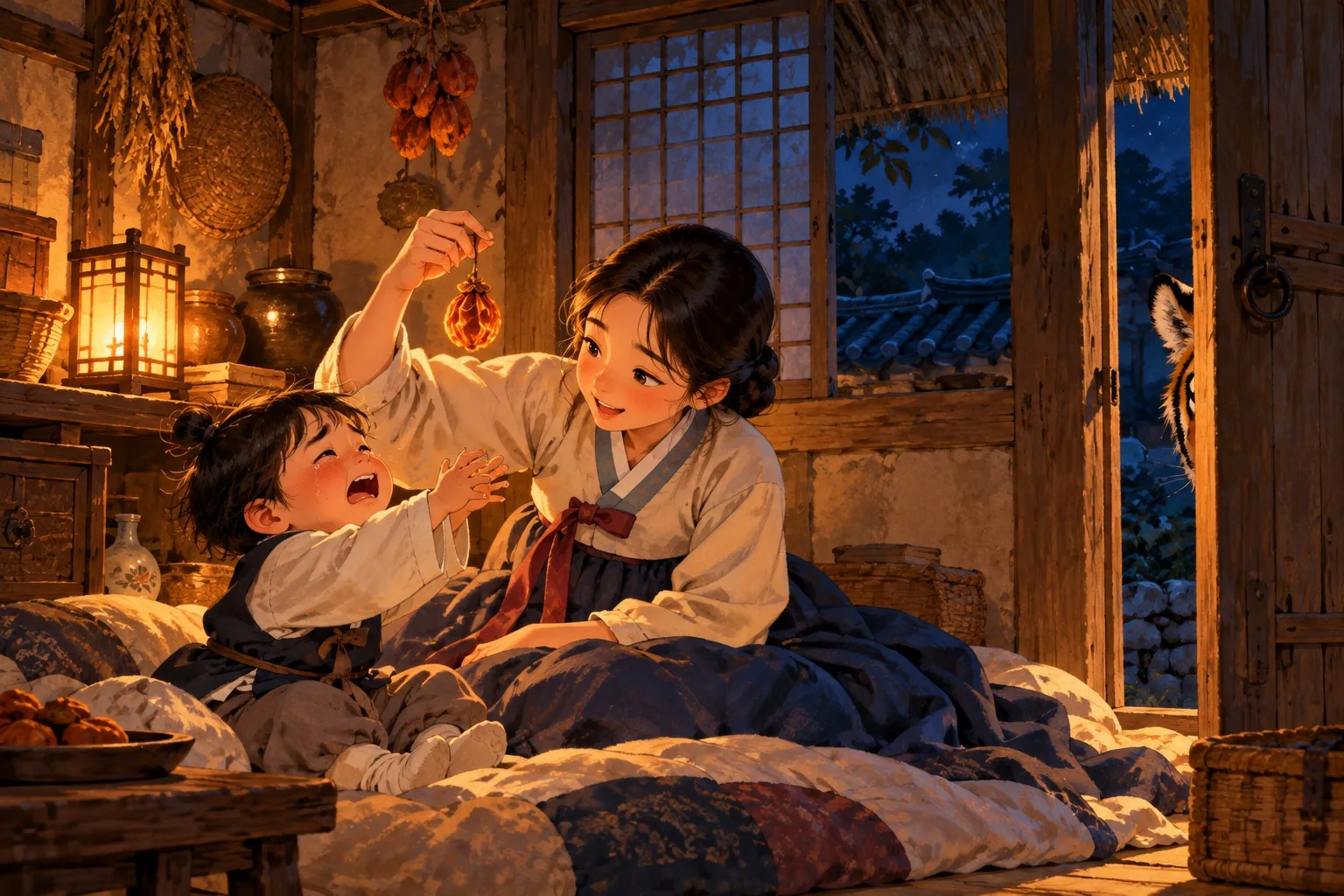
The tiger’s ears went flat against its head. The bear hadn’t worked. The fox hadn’t worked. Even the tiger, the king of the mountains, hadn’t worked. But one mention of this thing called a gotgam, and the child was too terrified to make a sound. The tiger had never heard of a gotgam, which only made it worse. Whatever it was, the tiger decided, it had to be something far more dreadful than any tiger.
Now, that same night, a thief had been watching the farmer’s house. He had heard about the new calf and planned to steal it while the family slept. He crept into the yard with a rope in his hand and felt his way into the pitch-black shed. His fingers touched a warm, furry back. That’s a big calf, he thought, and a sleepy one too. As quietly as he could, he found the calf’s halter rope lying in the straw, looped it around the animal’s neck and gave it a tug.
The tiger nearly jumped out of its skin. Something had crept up on it in the dark and caught it around the neck without a sound, at the very moment the children had been talking about the persimmon. There was only one explanation. The gotgam had come for it.
Too frightened to fight, the tiger got up and followed wherever the rope led. The thief, pleased with how easily the calf was coming along, walked quickly out of the yard and up the valley path without looking back, the rope over his shoulder and the “calf” padding along obediently behind him. They walked like that all night, over streams and along the ridges, the thief dreaming of the money he would get at market and the tiger wondering what terrible thing the gotgam would do to it when they arrived.
As the sky began to turn grey, the thief decided to take a look at his prize. He turned around and found himself face to face with a huge striped head. He dropped the rope and ran for his life. There was no time to go far, but beside the path stood an old, broken tree with a hollow trunk, and he scrambled up and squeezed himself inside it. The tiger, for its part, was so relieved to be let go that it didn’t chase him at all.
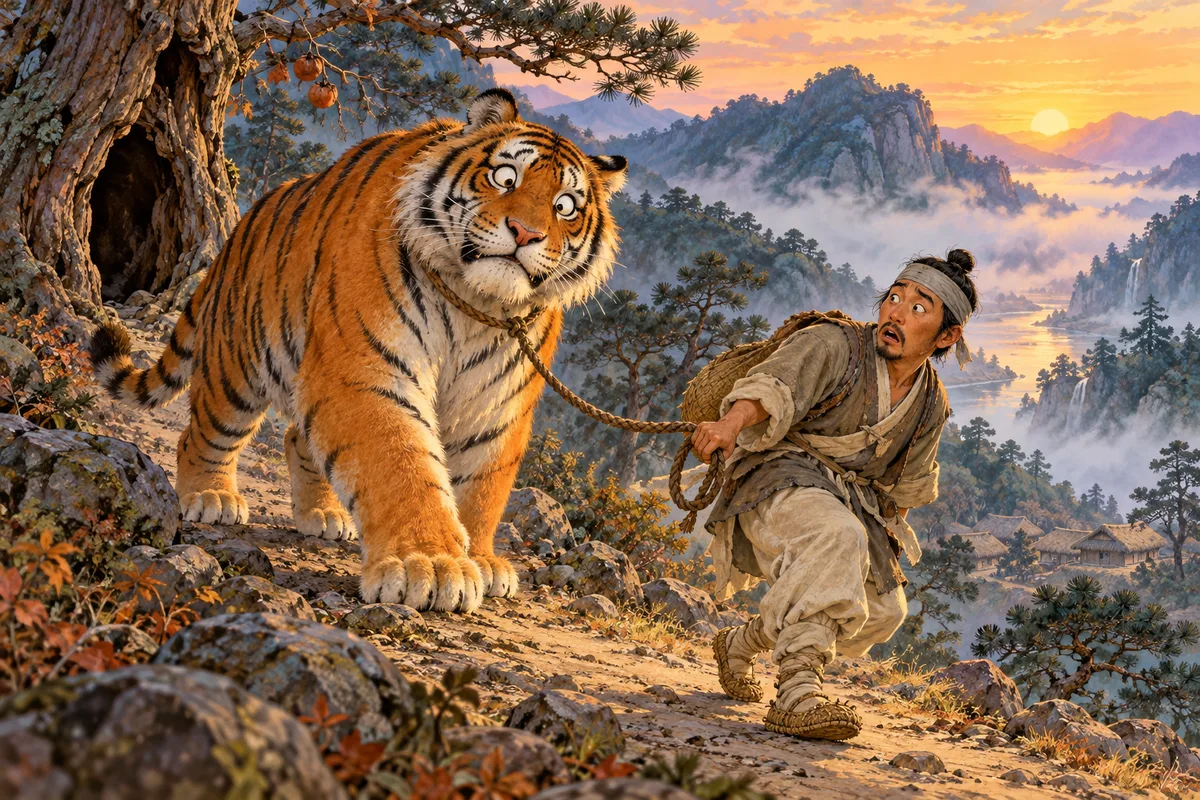
A little later, an old bear came ambling down the path. The bear was an old friend of the tiger’s, and it called out cheerfully, “Out early! How was the hunting last night?”
“Hunting?” said the tiger, still shaking. “I nearly didn’t make it home. I was caught by a gotgam, the most frightening creature in the world. It dragged me around the mountains all night long. It’s hiding in that tree right there. Whatever you do, don’t go near it.”
The bear had lived a long time and had never heard of any gotgam. “Rubbish,” it said. “I’ll go and see for myself.” It lumbered over to the old tree and peered into the hole. Inside, squashed against the wood and trembling, was a man.
The trunk was too thick for the bear to break open, and the man was too far down to reach. So the bear had an idea. It sat down right on top of the hole, blocking it with its big furry backside, so that the man inside would run out of air. It got comfortable and waited.

Down in the dark, the thief knew he was in serious trouble. Then he remembered the bit of cord he always carried for tying up stolen animals. He made a quick loop, reached up toward the furry bottom that was blocking his only way out, caught hold of the part of the bear that hurt the most, and pulled as hard as he could.
The bear shot into the air with a roar. “Aaargh! I’m dying! It’s killing me!” it bellowed, hopping about in agony.
That was all the tiger needed to see. It had warned the bear, and the bear hadn’t listened, and now the gotgam had got it too. The tiger didn’t wait to find out what had happened. It turned and bolted for the deepest part of the mountains, shouting back over its shoulder, “I told you so! Didn’t I tell you the gotgam was terrifying?”
And to the end of its days, the tiger never found out that the most frightening creature in the world was a sweet, chewy, perfectly harmless piece of dried fruit.
What is a gotgam?

A gotgam (곶감) is a persimmon that has been peeled and hung up to dry in the cold autumn wind. Over several weeks it turns dark orange, chewy and very sweet, and a pale, sugary bloom forms on the outside. Strings of persimmons drying under the eaves of a farmhouse are still one of the classic sights of the Korean countryside in late autumn, and gotgam remain a popular snack and a traditional gift. In the old days, when sweets were rare, a dried persimmon really could stop a child crying in a second, which is exactly why the big sister in the story reaches for one.
The tiger in Korean folktales
The tiger in this story is a good introduction to how Korean folklore treats tigers. In the old tales the tiger is the king of the mountains, and people genuinely feared it, because real tigers lived on the Korean peninsula until the early twentieth century. Yet storytellers loved to bring it down to size. Korean folktales are full of tigers that are tricked by rabbits, fooled by children, flattered by clever travellers and outwitted by mothers. Old stories often begin with the phrase “long ago, when tigers smoked pipes” (호랑이 담배 피우던 시절), which tells you straight away that the tiger here is going to be more of a character than a monster.
The same mix of fear and fun shows up in folk painting. In the popular “tiger and magpie” pictures, the tiger often has a goofy grin and big round eyes, looking more like a cartoon than a predator. The Tiger and the Dried Persimmon fits right into that tradition.
Talk about it
Why does the tiger decide the gotgam must be worse than itself, even though it has never seen one? Have you ever been more scared of something you didn’t understand than something you did? And who do you think was more frightened by the end of the night, the tiger or the thief?
Where this story comes from
Because this tale was told out loud for generations, it changes from village to village. The retelling above follows one complete version recorded in 1982 in North Jeolla province, in which the thief leads the tiger away on the calf's rope and an old bear joins the story at the end. In many other versions, which are probably the ones most Koreans learn as children, the thief jumps onto the tiger's back thinking it is a calf, and the tiger gallops wildly through the night trying to throw off the "gotgam" until the thief grabs a branch and escapes. Some short tellings stop as soon as the tiger runs away from the house. Others give the bear's part to a rabbit or a fox. The heart of the story stays the same in every version: a baby goes quiet for a persimmon, a tiger jumps to the wrong conclusion, and nobody ever tells it the truth.
What it means
The joke works because everyone in the story is wrong at the same time. The big sister only wants her baby brother to stop crying. The baby only wants a treat, because a dried persimmon is sweet and chewy and was one of the best snacks a child could get in a Korean winter. The thief thinks he is stealing a calf, the tiger thinks it is being hunted, and the bear thinks it has trapped an easy breakfast. Nobody actually knows what is going on, and the most powerful creature in the story ends up the most frightened, beaten by a fruit.
Under the comedy is a real idea about fear. The tiger is not scared of anything it can see. It is scared of a word it has never heard, and it fills that empty space with the worst monster it can imagine. It also assumes that fear is the only thing that could make the baby go quiet. The children tried danger and got nowhere, then offered something nice and got instant silence, but the tiger never considers that wanting something can explain a reaction just as well as being afraid of it. And when the bear goes to check and comes back howling, the tiger takes that as proof, so every new clue only makes it more sure of its mistake. That is a very human thing to do, and it is one reason the story has lasted. Korean adults still use "the tiger and the dried persimmon" as a way of saying that someone is afraid of something that turns out to be harmless.
Sources & further reading
This retelling follows the complete sequence of "호랑이보다 무서운 곶감" ("The Dried Persimmon More Frightening Than a Tiger"), told by Ahn Su-mun, aged 56, and recorded on 7 August 1982 in Daeya-myeon, Okgu-gun (now Gunsan), North Jeolla, collected in the Compendium of Korean Oral Literature (한국구비문학대계) 5-4. It is an English adaptation, not a translation. For comparison: Choi In-hak, "호랑이와 곶감", Encyclopedia of Korean Culture (Academy of Korean Studies), and "Tiger and Dried Persimmon", Encyclopedia of Korean Folk Culture (National Folk Museum of Korea).
- Academy of Korean Studies · 호랑이보다 무서운 곶감 · Ahn Su-mun, recorded 7 August 1982 ↗
- Encyclopedia of Korean Culture · 호랑이와 곶감 ↗
- National Folk Museum of Korea · Encyclopedia of Korean Folk Literature · 호랑이와 곶감
Illustrations are imaginative interpretations, not historical records. Read our editorial policy.