There was once a man so lazy that the neighbours said his shadow did more work than he did. He slept until the sun was high, he napped after lunch, and in the evening he lay on the warm floor and complained that he was tired. His wife wove cloth day and night to keep them fed.
If the roof leaked, he said he would fix it tomorrow. If the field needed hoeing, he said it looked like rain. If someone asked him to help carry something, he suddenly remembered a pain in his back. His wife hauled the water, cooked the rice, mended the clothes, and sat up late at her loom by the light of a tiny oil lamp, while he snored on the warm floor beside her.
At last his wife had had enough. She took down two bolts of fine silk she had woven and counted out five nyang of money, everything they had saved.
“Take these to the market,” she said, “and buy us an ox. With an ox we can plough the field and live properly. Please, just this once, do something useful.”
The man looked at the silk and the coins, and for once he sat up straight. “Of course,” he said. “Leave it to me. I’ll find the finest ox in the market.” His wife watched him go down the road and dared, for a moment, to hope.
The man promised he would. He tucked the silk under his arm and the coins in his sleeve and set off down the road, whistling. But he had no intention of buying an ox. He was thinking of the wine houses in town, and of how many lazy days five nyang would buy him.
It was a warm spring morning. The road was long and dusty, and before he had gone very far he sat down under a tree to rest, and then decided to have a little nap, and then decided he deserved another. By the time he set off again, the sun was already sliding down the sky.
The old man and the mask
On the way, he passed a little hut by the roadside. An old man sat in the doorway, carving something out of wood and straw. As the lazy man came closer, he saw that it was a mask in the shape of an ox’s head, with curving horns and big, mild eyes.
“What is that for, grandfather?” he asked.
He leaned on the fence and watched for a while. It was easier than walking. The old man’s knife moved slowly and carefully, and curls of pale wood dropped into his lap.
“Oh, this?” said the old man, without looking up. “It is for anyone who does not want to work. Put it on, and you will never have to lift a finger again.”
The old man’s voice was dry and mild, and there was something in his eyes, a sort of quiet amusement, that the lazy man did not notice.
The lazy man laughed. That sounded exactly like the life he wanted. “Let me try it,” he said.
The old man handed it over. The lazy man lifted the mask and put it on his head, meaning to pull a funny face and take it straight off. But as soon as it touched him, the mask seemed to grow onto his face. He tugged at it. It would not budge. He tried to shout, and what came out of his mouth was a long, low moooo.
He looked down. His hands had become hooves. A tail swished behind him. He was an ox.
He staggered on four legs, bellowing in terror. The old man put down his knife, stood up, and looked at him without the least surprise.
“There,” he said. “Now you will never have to lift a finger again. Oxen don’t have fingers.”
A long hot summer
The old man calmly tied a rope around the ox’s neck and led him to the market. There he sold him to a farmer. Just as the farmer was leading the ox away, the old man called after him.
“One thing,” he said. “Whatever you do, never let this ox eat a radish. If he eats a radish, he will die.”
The farmer nodded and took his new ox home. The next morning, at first light, the lazy man found himself yoked to a plough. All day he dragged it up and down the fields under the burning sun, with the farmer’s stick tapping his back whenever he slowed down. At night he lay in a smelly stable and ate straw. The next day was the same, and the next, and the next.
The farmer’s house was small and poor, and the farmer and his family worked from dawn until dark. The lazy man saw the farmer’s wife carrying water on her head before the sun was up, and the children out in the fields pulling weeds, and the farmer himself coming in at night so tired he could barely eat.
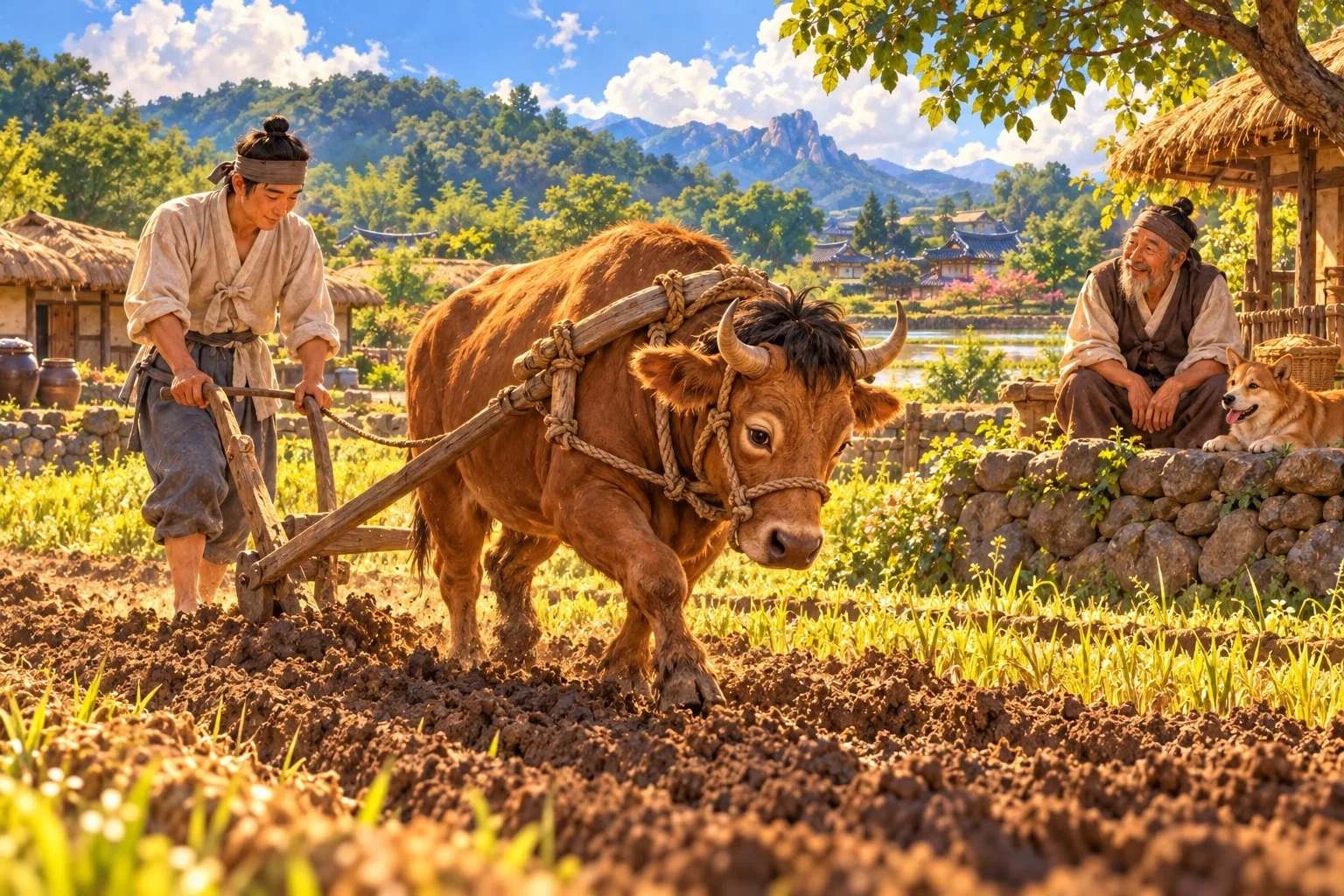
He tried to tell the farmer who he was, but all he could say was moooo. He thought of his wife weaving late into the night, and for the first time in his life he understood how tired she must have been.
He tried to lie down in the furrow and refuse to move, the way he used to lie on the floor at home, but the farmer only tapped him harder and clicked his tongue until he got up. He tried to run away, but the rope held him. The flies bit him, the yoke rubbed his neck raw, and the sun beat down on his back. By the end of each day his legs shook so much he could hardly walk back to the stable.
He thought of every time his wife had asked him for help and he had rolled over and gone back to sleep. Lying in the straw at night, he wept big, slow ox tears, and the farmer’s children, peeping into the stable, wondered why the new ox looked so sad.
The radish field
The summer passed, and autumn came. One day, as the farmer led him home past a field, the ox saw rows of fat white radishes pushing up out of the earth.
He remembered the old man’s warning. If he eats a radish, he will die. By now he was so worn out and miserable that he thought dying might be better than another summer at the plough. He pulled free of the rope, lowered his great head and bit into a radish.
He stood there for a long moment, looking at the radishes. The farmer had stopped to talk to a neighbour and was not watching. The rope hung slack.
At once the mask split and fell away. His hooves turned back into hands, his tail vanished, and there he stood in the radish field, a man again, blinking in the sunlight.
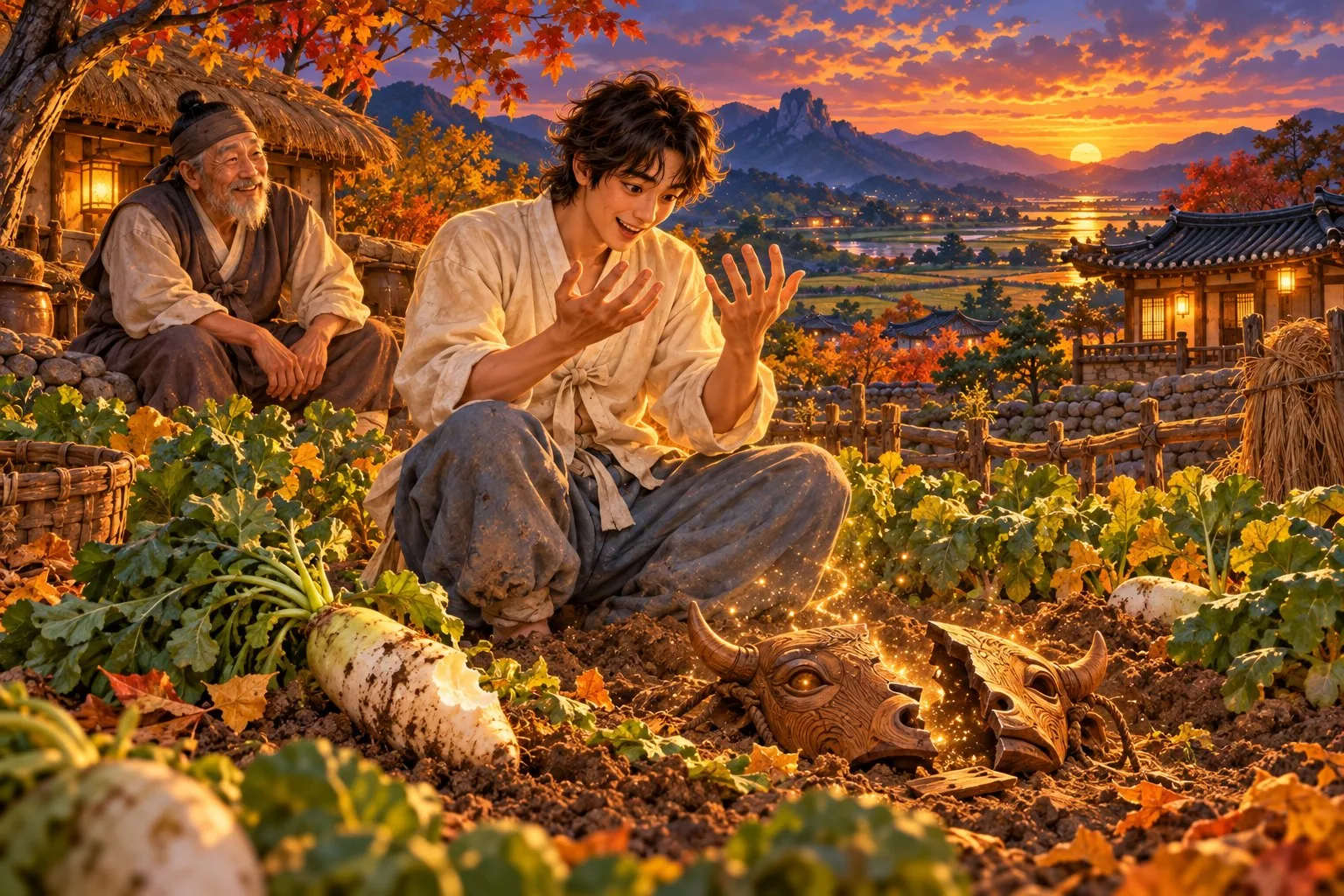
He ran all the way home.
He ran past the market and the wine houses without even looking at them. He ran until his lungs burned, and it felt wonderful to run on two legs again. His wife stared at him as if he were a ghost, for she had thought he had run off with the money for good. He told her everything. And from that day on, the neighbours said, he was the first one in the village up in the morning and the last one home from the fields.
A darker ending
Not every teller lets the old man off so easily. In one version recorded by the Encyclopedia of Korean Folk Culture, the man goes back to the hut after he becomes human again, tricks the old man and his wife into putting on ox masks themselves, and carries away all the gold and silver hidden in their house. That version is less about learning to work hard and more about turning the tables on a trickster.
Talk about it
Was the old man cruel, or did he do the lazy man a favour? Why do you think the cure is something as ordinary as a radish? Is there anything in your life you would only appreciate after trying someone else’s job?
Words to know
So (소) means ox or cow. Geeureumbaengi (게으름뱅이) means a lazybones. Mu (무) is the Korean white radish, used in kimchi and soups. Nyang (냥) was a unit of money in old Korea.
Where this story comes from
So-ga doen geeureumbaengi (소가 된 게으름뱅이), "the lazy man who became an ox", has been collected from storytellers in many parts of Korea and appears in the great national survey of oral literature, the Hanguk gubimunhak daegye. The Encyclopedia of Korean Folk Culture summarises the most common version: a lazy husband takes cloth and money from his wife, saying he will buy an ox, puts on an old man's ox mask, turns into an ox, and is finally saved by eating a radish.
The details shift from teller to teller. Sometimes the hero is a lazy son, sometimes a married scholar who does nothing but sit about. In a few versions he swaps hats with a stranger instead of putting on a mask. And in one darker version, the man goes back to the old craftsman's house afterwards, turns the old man and his wife into oxen, and walks off with their treasure.
What it means
The Encyclopedia of Korean Folk Culture connects the story to a Buddhist idea that many Koreans grew up with: that a person who lives idly may be reborn as an ox or a horse to work off their debts. In this tale the punishment arrives in a single lifetime, as a kind of small rebirth, and the man is allowed to come back and try again.
The ox was the most important animal on a Korean farm, almost a member of the family. It was patient, strong and never complained. So turning a lazy man into an ox is not just a joke about hard work. It forces him to live, for one long summer, with all the qualities he lacked. When the mask finally falls away, he is a different person.
Sources & further reading
Retold from the summary and variants in the Encyclopedia of Korean Folk Culture entry "소가 된 게으름뱅이". It is an English adaptation, not a translation.
- Encyclopedia of Korean Folk Culture · 소가 된 게으름뱅이 (the lazy man who became an ox) ↗
- Encyclopedia of Korean Folk Culture · 소가 된 사람의 복수 (the man who became an ox takes revenge) ↗
Illustrations are imaginative interpretations, not historical records. Read our editorial policy.