In a mountain village there lived an old man with a lump on his cheek as big as a pear. It wobbled when he walked and bounced when he laughed, and the children called him Old Lump. He did not mind. He was a cheerful old man, and he loved to sing.
He sang while he worked in his little field, and while he swept his yard, and while he walked to market. The villagers said you always knew where Old Lump was, because you could hear him from three fields away. He was poor, and he lived alone in a small cottage at the edge of the village, but he was never heard to complain.
One autumn day he went up the mountain to cut firewood. He worked so long that the sun slipped behind the ridge before he noticed, and by the time he had tied up his bundle it was dark. The path down was steep and he could not see his feet, so he looked for somewhere to spend the night.
It was a fine day, crisp and bright, with the maples turning red on the slopes. He sang as he swung his axe, and the birds sang back at him, and he was so happy in his work that he quite forgot to watch the sky.
Not far off he found an empty house, old and tumbledown, with its doors hanging loose. He crept inside, set his firewood in a corner and sat down to wait for morning.
It was a gloomy place. Cobwebs hung from the beams, the paper in the windows was torn to rags, and the wind moaned through the gaps in the walls. Somewhere in the dark a loose shutter banged, and banged again. The old man had heard stories about empty houses in the mountains and what came to them at night, and he tried very hard not to remember any of them.
Midnight visitors
The night was long and the house was cold and creaky. To keep his spirits up, the old man began to sing. He had a fine, rich voice, and the old songs rolled out of him one after another, filling the empty rooms.
He sang farming songs and boatmen’s songs, love songs and sad songs, the songs his mother had sung to him when he was small. And as he sang, he forgot to be afraid. The empty house almost seemed to be listening.
Around midnight, he heard a commotion outside: thumping and shuffling and high, squeaky voices. The door burst open, and in tumbled a whole crowd of dokkaebi. Some had one horn and some had two. Some were tall and some were tiny, and all of them carried clubs.
The old man’s heart nearly stopped. But the dokkaebi did not attack. They sat down in a ring around him, their eyes shining.
“Sing again!” they cried. “Sing more!”
One of the smallest ones bounced up and down with excitement. A big one with a single horn wiped a tear from his eye with a hairy hand. “That last one,” he sniffed. “The sad one. Sing that one again.”
So he sang. He sang every song he knew, and the dokkaebi clapped and stamped and swayed. When at last he stopped for breath, the chief dokkaebi leaned forward.
“Old man,” he said, “how do you sing so beautifully? Where does that voice come from?”
The old man thought quickly. He tapped the lump on his cheek. “From this,” he said. “This is my song bag. All my songs are stored in here.”
The dokkaebi stared at the lump. They leaned closer. One of the little ones reached out a finger and poked it, very gently, and the old man had to bite his lip to keep from laughing.
Selling the song bag
The dokkaebi gasped. They whispered and muttered among themselves. Then the chief said, “Sell it to us! We will give you anything.”
The old man pretended to hesitate. “Oh, I could never,” he said. “Without my song bag I would never sing again.”
“But we must have it,” wailed a small dokkaebi. “We want to sing like that too!” And the others took up the cry, “Sell it! Sell it! Sell it!”, stamping their feet until the whole tumbledown house shook.
The dokkaebi begged and pleaded. They offered gold. They offered silver. They offered more. At last the old man sighed as if it broke his heart, and agreed. The chief dokkaebi reached out, gave the lump a twist, and plucked it off as easily as picking a plum. It did not hurt at all. Then the dokkaebi piled treasure at the old man’s feet and vanished into the night, carrying their precious song bag.
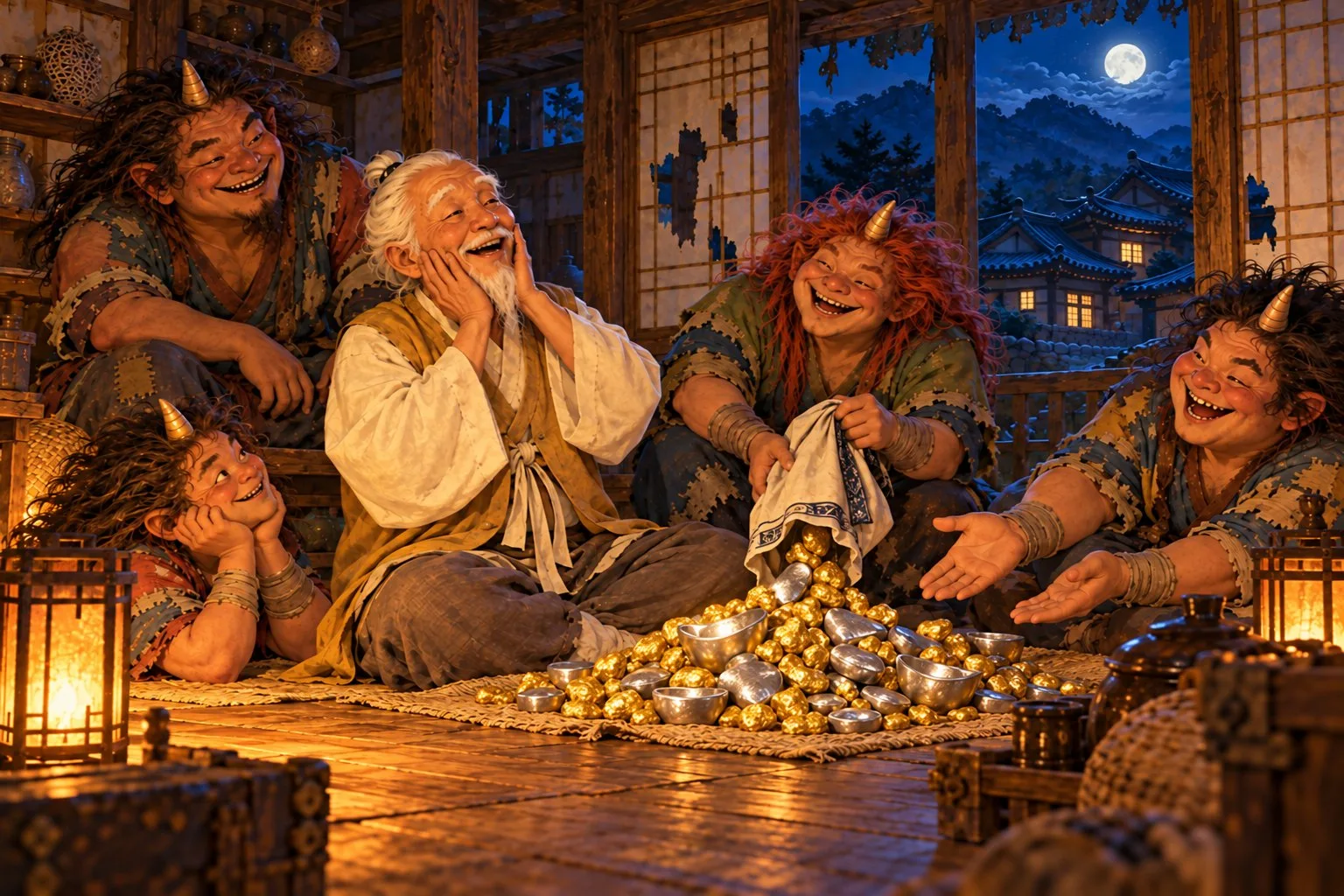
When morning came the old man felt his cheek. It was smooth. He walked down the mountain with his firewood on his back and his treasure in his arms, and he was rich for the rest of his life.
When he reached the village, the neighbours gathered round, staring at his smooth cheek and his heap of gold and silver. The old man told them the whole story, laughing so hard he could hardly get the words out. He mended his roof, bought a fat ox and a field, and shared his good fortune with anyone in the village who was in need. And he went on singing just as he always had.
The neighbour tries his luck
Now in the same village lived another old man who also had a lump on his cheek. He was greedy and sour-tempered, and when he heard how his neighbour had lost his lump and gained a fortune, he was green with envy.
He had never had a good word to say about his cheerful neighbour. “The old fool sings all day like a cricket,” he used to grumble. Now he stamped up and down his yard, scowling. Why should Old Lump be rich, and not him?
“If that old fool can do it, so can I,” he said. He climbed the mountain, found the same empty house, and waited until midnight. Then he began to sing. His voice was cracked and harsh, like a crow with a cold.
He had never sung in his life, and he did not know any songs properly. He croaked out half of one and forgot the words, then started another and went wrong, then simply made up a tune and bawled it as loudly as he could.
Sure enough, the dokkaebi came tumbling in. “Where does that voice come from?” asked the chief.
“From this!” said the greedy old man, tapping his lump. “It is my song bag. I will sell it to you for a good price.”
He rubbed his hands together and smiled greedily. “Gold first, please. Then you can have it.”
The dokkaebi went quiet. Then the chief stood up, and his eyes flashed. “Liar!” he roared. “We bought a song bag last night, and there was not a single song in it! You will not trick us twice!”
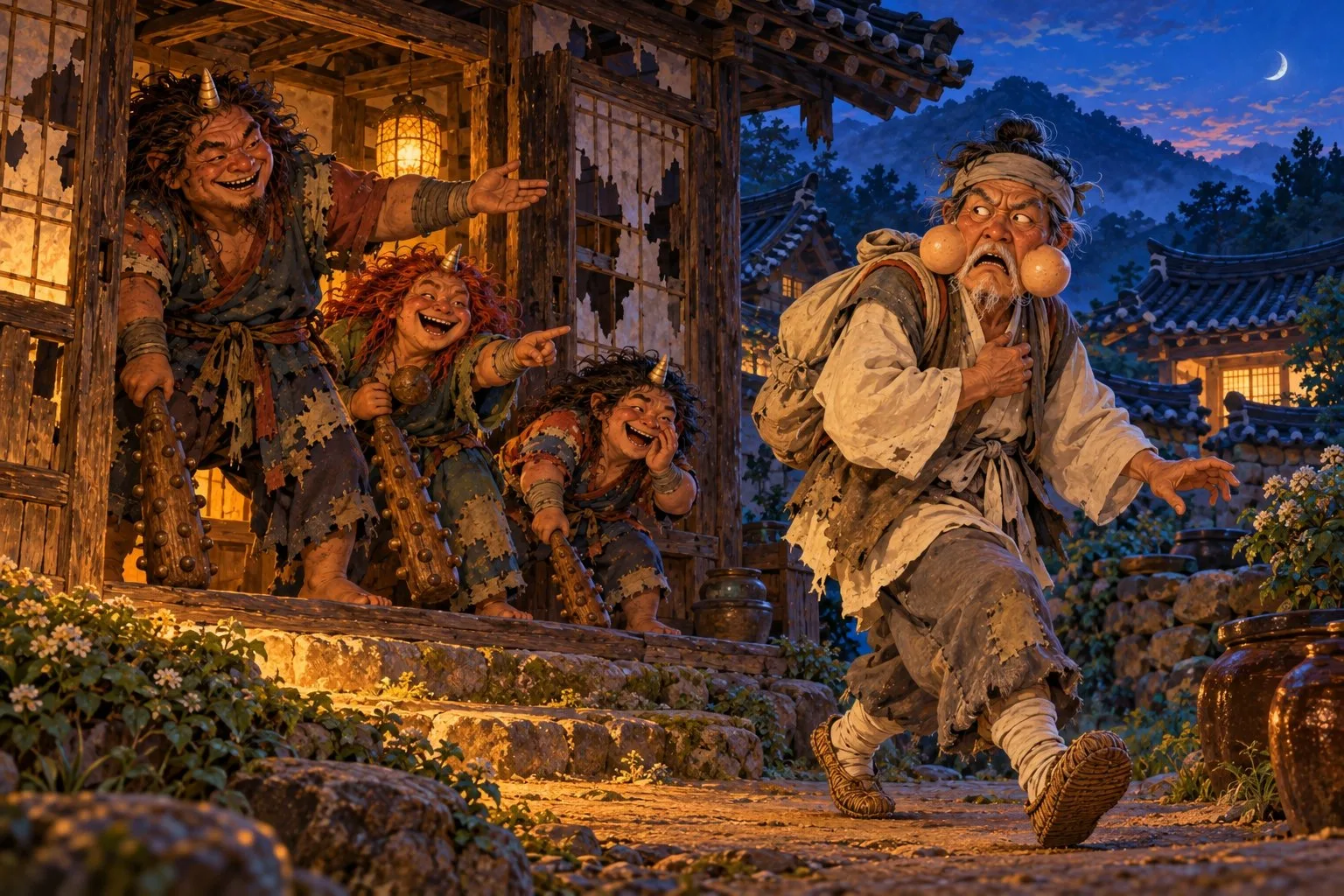
And he took the first old man’s lump out of his sleeve and slapped it onto the other side of the greedy man’s face, where it stuck fast. The greedy old man stumbled home in disgrace, with a lump on each cheek.
The other dokkaebi howled with laughter and pointed. Then, one by one, they vanished into the night, still giggling, and the greedy old man was left alone in the cold, dark house, feeling his face with trembling hands.
Whose story is it?
Almost the same story is told in Japan as Kobutori jiisan, and in Japan the old man often dances for the demons rather than singing. Because the Korean version first appeared in print in a Japanese collection and in colonial-era schoolbooks, some Korean scholars believe it came over from Japan. Others think it was a Korean tale long before that. Either way, by now it belongs firmly to Korean childhood, and the dokkaebi in it behave exactly like the dokkaebi of older Korean folklore: mischievous, gullible, and generous when they are pleased.
Talk about it
Was the first old man honest with the dokkaebi? Does he deserve his reward more than his neighbour? Why do you think stories so often punish the person who copies?
Words to know
Hok (혹) means a lump or bump. Yeonggam (영감) is a respectful word for an old man. Dokkaebi (도깨비) are Korean goblins who love music, games and wrestling. Mobangdam (모방담) is the term for an imitation tale.
Where this story comes from
Hokburi yeonggam (혹부리 영감), "the old man with the lump", is one of the best-known children's tales in Korea and is told in every region. The Encyclopedia of Korean Culture notes that it was printed in Takahashi Tōru's collection of Korean stories in 1910 and then in the school reader Joseoneo dokbon in 1915, and appeared in school textbooks throughout the colonial period.
Scholars disagree about where it began. Japan has a very similar tale, Kobutori jiisan, and the story does not appear in older Korean written collections, so some argue it came to Korea from Japan and was spread through colonial schoolbooks. Others argue it was a Korean tale all along, and that the Japanese authorities used the likeness between the two to promote the idea that Korea and Japan were one. A Joseon-era writer, Kang Hang, recorded a similar story he heard while he was held captive in Japan.
What it means
This is an imitation tale: one person does something and is rewarded, and a second person copies it and is punished. The same pattern turns up all over the world, and in Korea in stories like The Golden Axe and the Silver Axe and Heungbu and Nolbu.
The Encyclopedia of Korean Culture points out something interesting. In the similar tale of the dokkaebi club, the hero is a kind, dutiful son, so the story is clearly about good being rewarded. But the first old man here is not especially good. He is just quick-thinking. So the story is less about virtue and more about being the original rather than the copycat. The dokkaebi, as usual, are both powerful and silly: they can lift a lump off and stick it on again at will, yet they believe a song comes out of a lump.
Sources & further reading
Retold from the outline of the tale in the Encyclopedia of Korean Culture entry "혹부리 영감 설화". The bargaining scene is expanded, as many Korean tellers do. It is an English adaptation, not a translation.
- Encyclopedia of Korean Culture · 혹부리 영감 설화 (the old man with the lump) ↗
- Encyclopedia of Korean Culture · 도깨비 설화 (dokkaebi tales) ↗
Illustrations are imaginative interpretations, not historical records. Read our editorial policy.