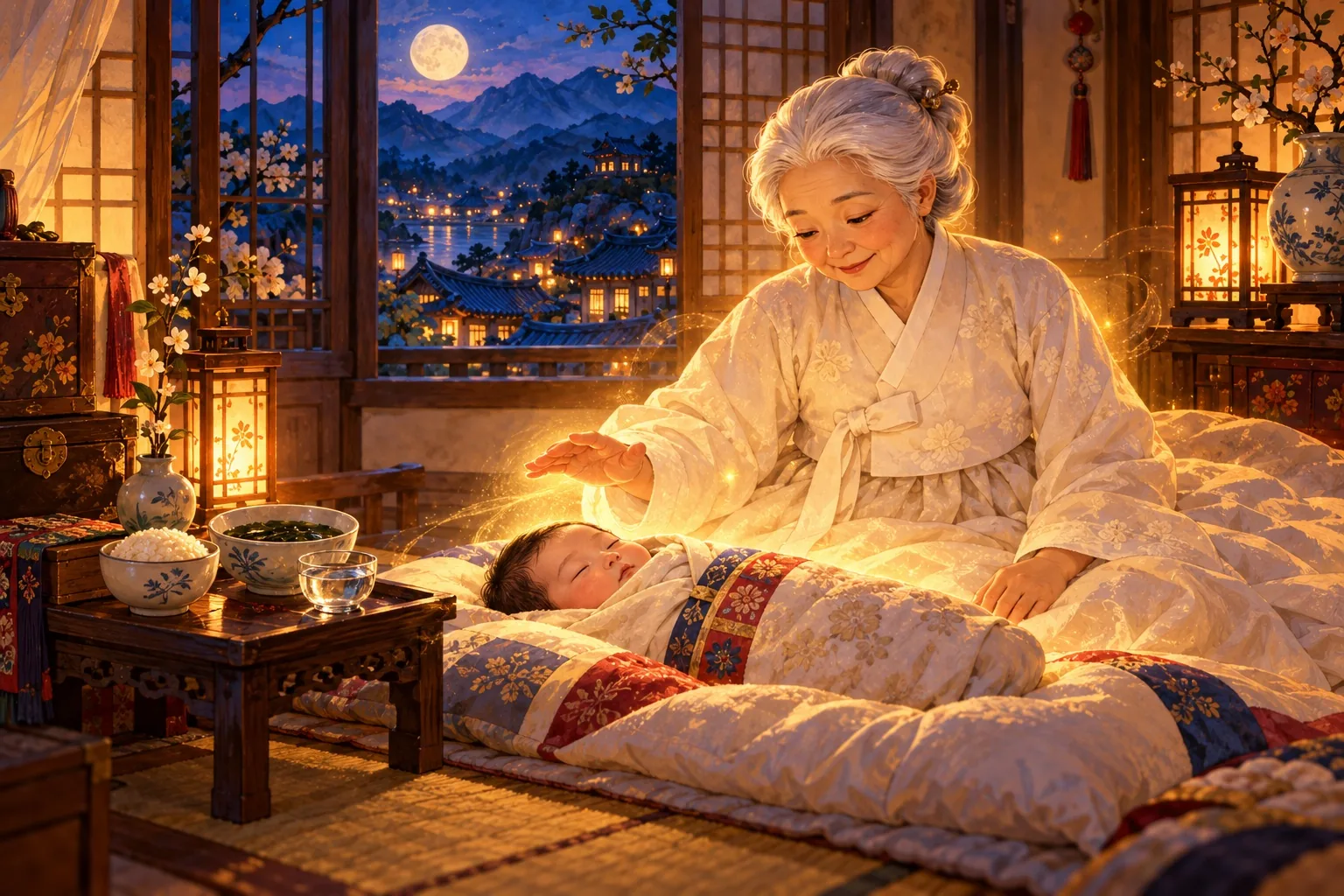
Ask a Korean grandmother where babies come from and, in the old days at least, she might have given you a one-word answer: Samsin. Samsin Halmeoni (삼신할머니), “Grandmother Samsin”, is the goddess who decides when a child will be conceived, helps it to be born safely and protects it through the dangerous years of early childhood. She is one of the most loved figures in Korean folk religion, and even people who never think about the old gods still use her name in everyday sayings about babies and luck.
A goddess who lives in the house
Samsin is one of the gasin, the household gods who were believed to live inside a traditional Korean home, each in a particular place. The Encyclopedia of Korean Culture explains that her name probably comes from an old Korean word sam, connected with pregnancy and the womb, which survives in words such as samjul, the umbilical cord. So Samsin is, quite simply, the goddess of the womb.
Families kept a small shrine for her in the main room of the house, the anbang, where the women of the family slept and where babies were born. What it looked like depended on the region. In central Korea, the encyclopedia says, families filled a long cloth bag with rice, topped it with a little peaked cap of mulberry paper and hung it in a corner of the room. In the Yeongnam region of the southeast, it was a large gourd bowl filled with rice and covered with paper, set on a shelf, sometimes with a skein of thread laid on top as a wish for long life. In Honam, in the southwest, families used a pottery jar. On holidays, birthdays and memorial days, a little of the family’s food was offered to her.
Rice and seaweed soup
When a baby was born, the family set out a samsinsang, a small table for Samsin, to pray for the health of mother and child. The encyclopedia records that it usually held bowls of rice and miyeokguk, seaweed soup, often three of each. Seaweed soup is still the dish a Korean mother eats after giving birth, and it is still what Koreans traditionally eat on their birthdays, in memory of the day they were born.
Samsin’s care did not end with the birth. Because young children so often fell ill, families went on honouring her as their children grew, asking her to keep them safe.
The rope across the gate
Another custom kept harm away from a newborn. As soon as a baby arrived, the family hung a geumjul, a taboo rope, across the front gate. The encyclopedia explains that it was twisted from rice straw to the left, the opposite of an ordinary rope. For a boy, red chilli peppers and lumps of charcoal were tucked into it; for a girl, small sprigs of green pine and charcoal. Regional versions used dried seaweed, pebbles or a small knife.
The rope was a clear sign: no visitors. Anyone outside the household, even close relatives who lived elsewhere, kept away while it hung, usually for three weeks. People believed that if outsiders came and went, they might bring impurity into the house, Samsin would be angered, and the baby could come to harm.
How the birth goddess got her job
On Jeju Island, shamans tell a sacred myth explaining how the goddess of birth, there called Samseung Halmang, came to her role. It is chanted during rituals for children, and the encyclopedia retells it.
The Dragon King of the Eastern Sea had a daughter who was always getting into trouble, and at last her father decided to send her away. Her mother, the queen, took pity on her. “Go and live in the human world as the goddess who gives women children,” she said, and began teaching her daughter the secrets of pregnancy and childbirth. But before she could explain how to deliver a baby, the girl was sealed in a stone chest and cast into the sea.
The chest washed up in the human world, where it was found by a childless scholar named Im. The Dragon King’s daughter went home with him and, just as her mother had taught her, gave his wife a child. The baby grew and grew in the womb. Ten months passed, then eleven, then twelve, and still it was not born, because the goddess had never learned how to bring it out. In desperation she tried to deliver it through the mother’s armpit, and mother and child came close to dying.
Scholar Im cried out to the Jade Emperor, the king of heaven, for justice. The Jade Emperor chose a wise maiden, the daughter of the land of Myeongjin, and sent her down to earth to be the true goddess of birth. When the two young goddesses met, they quarrelled over which of them should have the job, and finally went before the Jade Emperor to be judged.
The Jade Emperor gave them a test. Each would plant a flower and tend it, and whoever grew the finer flower would become the goddess of birth. The two maidens planted their flowers. The Dragon King’s daughter’s flower struggled, but the Myeongjin maiden’s flower grew strong and blossomed abundantly.
So the daughter of Myeongjin became Samseung Halmang. Carrying the flowers of the western flower garden, which decide each child’s fate, she travels busily from house to house, granting children, helping them into the world and raising them until they are fifteen. The Dragon King’s daughter was not forgotten. She became Gu-samseung Halmang, the goddess who takes charge of children who die before fifteen and guides them to the next world.
The encyclopedia notes that while Samsin is honoured all over Korea, this myth is found only on Jeju. Jeju shamans perform it in the buldomaji, a ritual asking for pregnancy, protection against miscarriage and healing for sick children.
Other faces of Samsin
On the mainland, the encyclopedia adds, shamans sometimes tell a different story. In the Jeseok bonpuri, a myth sung during gut, a young woman named Danggeum-aegi becomes the goddess of birth, or the role goes to the three Buddhas of the Jeseok gods. The details change, but the heart of the belief does not. In a time before modern medicine, when birth was one of the most dangerous moments in a family’s life, people placed it in the hands of a wise, kindly grandmother.
Read about the mudang and the gut ritual →
Quick facts
Samsin Halmeoni, or Samseung Halmang on Jeju, is the Korean goddess who grants children, helps them be born and protects them as they grow. She was honoured in the main room of the house with a bag, gourd or jar of rice. After a birth, families offered her rice and seaweed soup and hung a straw taboo rope across the gate to keep outsiders away. A Jeju myth tells how the daughter of Myeongjin won the role from the Dragon King’s daughter by growing the finer flower.