Long ago, near the town of Jeonju in Jeolla province, there lived a retired official named Choe Man-chun and his wife, Lady Jo. They had waited ten years for a child, and when a daughter was finally born they called her Kongjwi. Their happiness did not last. A hundred days after the baby arrived, Lady Jo died, and Kongjwi grew up with only her father to look after her.
When she was still a girl, her father married again. His new wife, Lady Bae, was a widow with a daughter of her own, called Patjwi. The names sound like a pair from the start: kong means soybean and pat means red bean, so the two girls were something like Bean and Red Bean. But they were not treated like a pair. The stepmother doted on her own daughter and could hardly stand the sight of Kongjwi. Patjwi slept late and ate the best of everything. Kongjwi cooked, swept, washed, carried water and worked in the fields, and was scolded whatever she did.
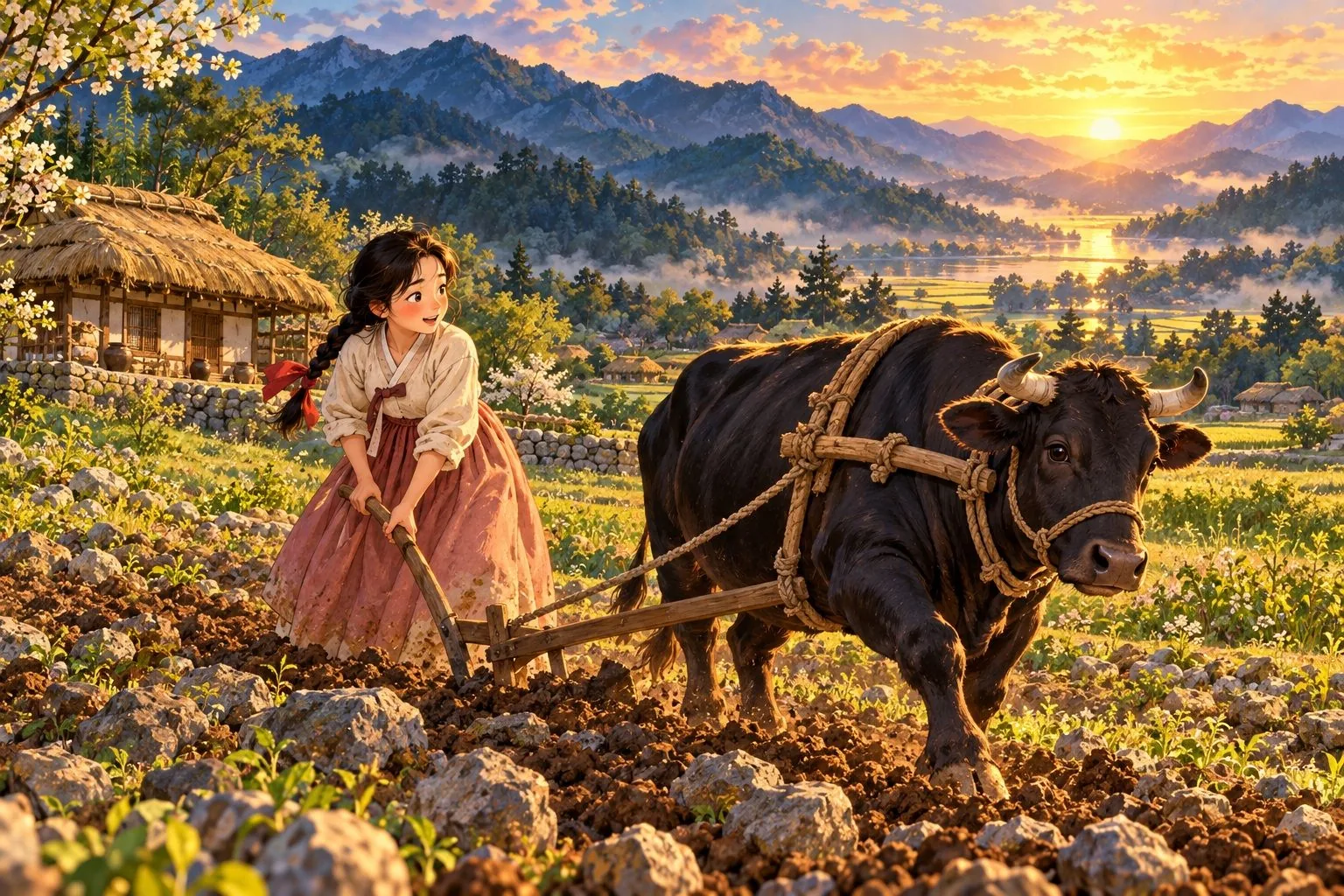
One morning in spring the stepmother handed Patjwi a fine iron hoe and sent her to weed the soft, sandy field close to the house. Then she gave Kongjwi a hoe made of wood and pointed up the mountainside. “The stony field,” she said. “All of it, before dark.”
The hillside field was more rock than soil. On the first stroke the wooden hoe struck a stone and snapped clean in two. Kongjwi sat down among the rocks with the broken handle in her lap and cried, because she knew what would happen if she came home with the work undone. Then she heard a heavy footstep. A great black cow was walking down the slope toward her. It looked at her with calm dark eyes, lowered its head and set to work, and in no time at all every weed in the stony field was gone. Before it left, it showed her a stream where fruit hung over the water, sweeter than anything she had tasted, so that she would not go home hungry.
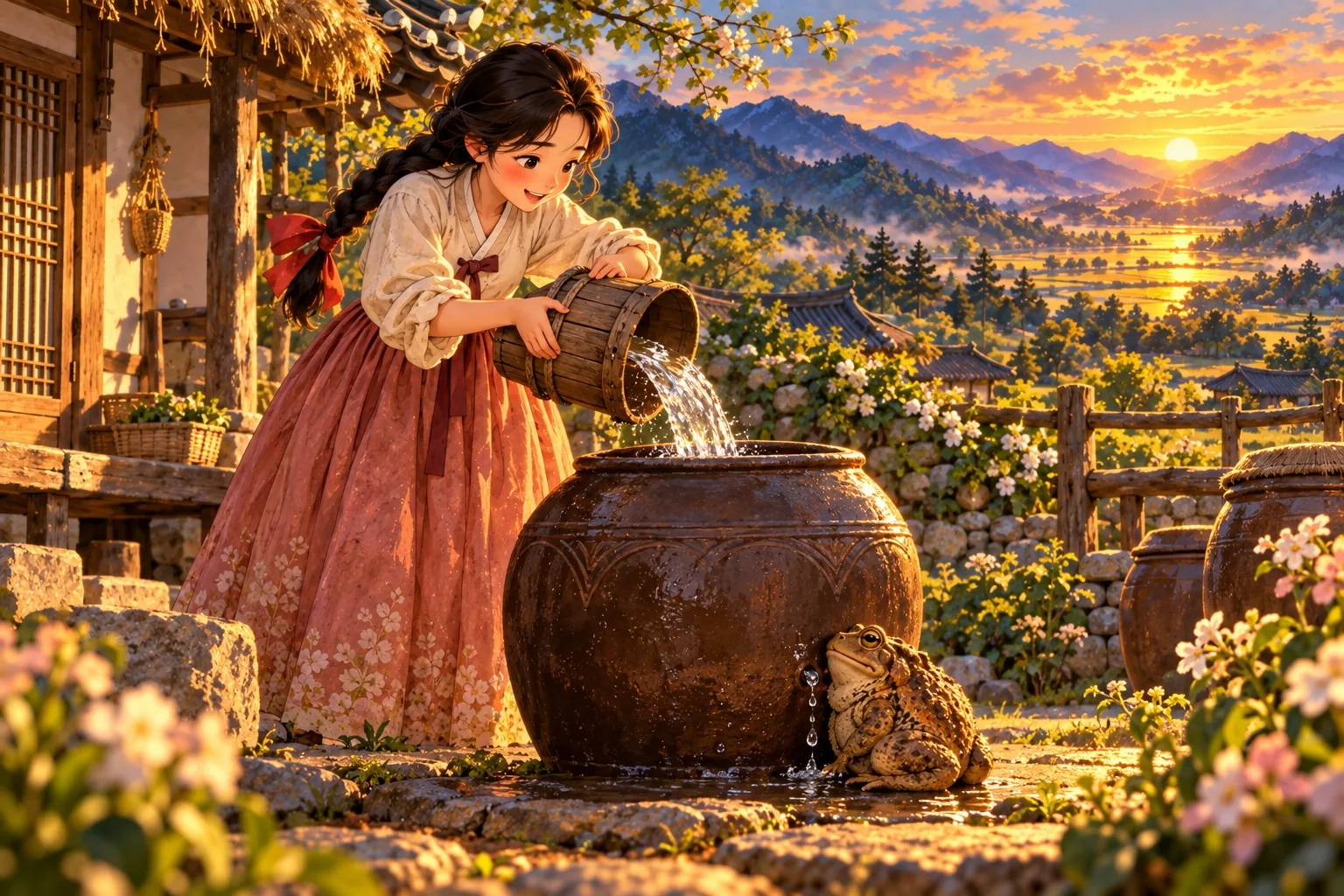
The stepmother was furious to find the work done, and the next tasks were worse. A relative was holding a great feast, and Lady Bae and Patjwi dressed in their best to go. Before they left, the stepmother pointed to an enormous earthenware jar in the yard. “Fill that to the brim with water,” she said. “Then husk all this rice, and weave this cloth. Finish everything, and perhaps you can come to the feast too.” She laughed as she went out of the gate, because she knew something Kongjwi didn’t. The jar had a hole in the bottom.
Kongjwi carried water from the well, pail after pail, until her arms ached and her feet were soaked, and the jar stayed as empty as when she began. She was just about to give up when a large brown toad crawled out from the shadow beside the jar. “Don’t cry,” it croaked. “I’ll help.” It squeezed itself in underneath and sat over the hole, and the next pail of water stayed in. Kongjwi filled the jar to the brim.
The sun climbed higher. Patjwi and her mother had long since left for the feast, laughing as they went out of the gate. Kongjwi sat down beside the jar at last, put her face in her wet hands and cried.
Then a whole flock of birds flew down into the yard and pecked away at the rice until every grain was clean and husked. And as she sat down in despair in front of the loom, a woman in shining robes stepped down from the sky. She was the Weaver Maiden, the goddess who weaves the clouds, and she finished the cloth in a moment. When she had done, she gave Kongjwi a lovely dress and a pair of embroidered silk shoes, and told her to hurry to the feast.
Kongjwi ran along the road in her new clothes, her heart pounding. Just as she reached a stream, a grand procession came the other way: banners, servants, soldiers and a curtained palanquin carrying the new provincial governor. Kongjwi was so startled that she hurried across the stepping stones, and one of her silk shoes slipped off her foot and vanished into the water. There was no time to look for it. She ran on to the feast with one bare foot, hoping no one would notice.
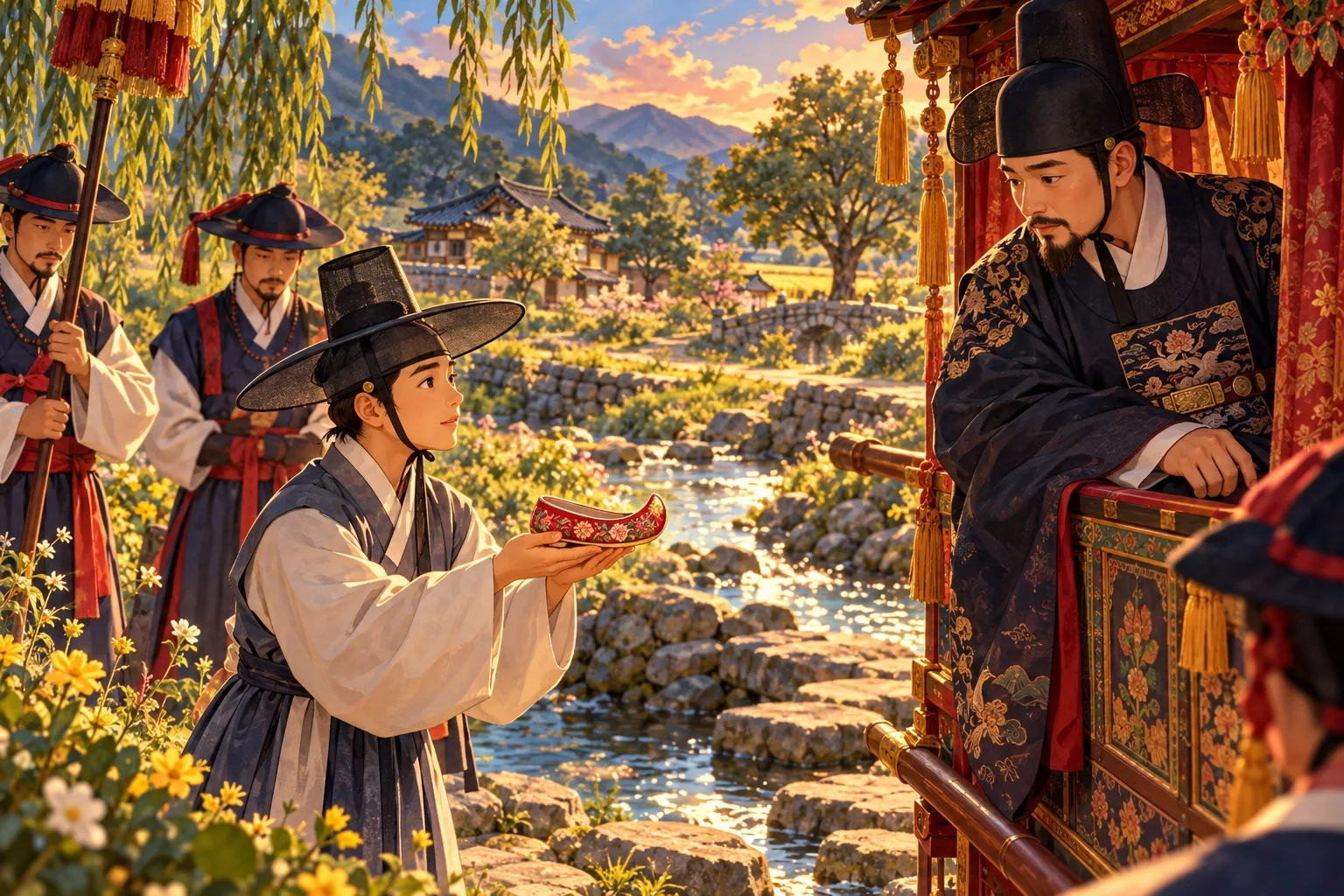
The governor’s men fished the shoe out of the stream. He turned it over in his hands. He had never seen such fine work, and he wanted to meet the woman who could wear it. He sent his men from house to house, and every girl in the district tried it on. Patjwi crammed her foot in as far as it would go and could not get it halfway. At last the search reached the corner where Kongjwi was sitting quietly. The shoe slid onto her foot as if it had been made for her, and from inside her jacket she took out its partner.
Before long, Kongjwi and the governor were married, and she went to live in his fine house. For the first time in her life, she was happy.
She had a room of her own with silk cushions and a carved chest, and servants who bowed when she passed. She ate rice that was hot and white and plentiful. Sometimes she woke in the night and lay very still, afraid that if she moved, she would find it had all been a dream.
In most picture books, that is the end. In the old story, it is only the halfway point.
Patjwi could not bear it. One day, while the governor was away, she came to visit and was all smiles and sweetness. She asked Kongjwi to walk with her in the garden and led her to the lotus pond. “Look how clear the water is,” she said. When Kongjwi leaned over to look, Patjwi pushed her in and held her under until she was still. Then Patjwi put on Kongjwi’s clothes, sat in Kongjwi’s room and waited. When the governor came home and asked why his wife’s face looked so different, she told him she had been ill, and that the illness had spoiled her skin. He believed her.
But Kongjwi did not rest. In the pond where she had died, a lotus bloomed, larger and more beautiful than any flower the governor had seen. He picked it and set it in his room. Every time Patjwi walked past, the flower caught at her hair and tugged it, and sometimes it seemed to whisper. In a rage, she tore it to pieces and threw it into the kitchen fire.
The next morning an old woman who lived nearby came to borrow embers, and in the ashes of the fire she found a bright glowing bead. She took it home and set it on her shelf. That night, a voice spoke from the bead, and then the shape of a young woman stood before her: Kongjwi. She told the old woman everything and asked her to invite the governor to a meal.
The governor came, and the old woman served him dinner. When he picked up his chopsticks, he frowned. One was long and one was short. “Who sets a table with mismatched chopsticks?” he grumbled. A voice answered him from behind the screen. “You notice a mismatched pair of chopsticks,” it said, “but you never noticed that your wife had been replaced?”
The governor went white. He ordered the lotus pond drained, and at the bottom they found Kongjwi, as untouched as if she were sleeping. And as they lifted her from the water, she opened her eyes and breathed again.
The ending most books leave out
The old printed novel does not end gently. The governor has Patjwi punished, and the punishment it describes is far too gruesome for a picture book. What remains of her is sent home to her mother, and when Lady Bae sees what has come back to her, she dies of shock on the spot. That is why most modern retellings stop at the wedding. Older audiences heard it as justice made visible: the people who caused so much suffering are destroyed by the very cruelty they started.
Talk about it
Why do you think Kongjwi’s helpers are a cow, a toad, birds and a weaving goddess rather than a fairy godmother? Should the story end at the wedding, the way most picture books do, or does the second half matter? And how is Kongjwi different from the Cinderella you know?
Words to know
Kong (콩) means soybean and pat (팥) means red bean. Kkotsin (꽃신) are traditional embroidered silk shoes. A gamsa (감사) was a provincial governor in the Joseon period, and a wonnim (원님) a local magistrate. Jingnyeo (직녀), the Weaver Maiden, is the goddess of weaving who appears in many Korean and Chinese tales.
Where this story comes from
Kongjwi and Patjwi was told aloud across Korea for a long time before anyone wrote it down, and nobody knows how old it is. In the early twentieth century the oral tale was turned into a short printed novel, Kongjwi Patjwi-jeon (콩쥐팥쥐전). The surviving editions include one from Daechang Seowon in 1919 and one from Taehwa Seogwan in 1928. The novel gives the characters full names and a setting: Kongjwi's father is Choe Man-chun, a retired local official living near Jeonju in Jeolla province, her mother is Lady Jo, and her stepmother is a widow, Lady Bae. In the novel Kongjwi marries a provincial governor, a gamsa; in many oral tellings he is the local magistrate, the wonnim.
The first half belongs to a worldwide family of stories about a persecuted stepdaughter, which includes the European Cinderella and the Chinese tale of Ye Xian, written down in the ninth century with its own lost slipper. The second half, in which the heroine is murdered after her wedding and comes back through a flower and a bead, is much closer to the Vietnamese tale of Tấm and Cám, where the heroine also returns through a series of transformations. Kongjwi is part of an Asian family of tales, not a borrowed copy of a European one. Korean scholars point to its ideas of rebirth and of goodness rewarded as deeply Korean values.
What it means
The first half is about endurance. Kongjwi never fights back against her stepmother. She keeps working, and when the tasks become truly impossible, help arrives from the world around her. It is worth noticing who those helpers are. Instead of a fairy godmother, Kongjwi is rescued by a black cow, a toad, a flock of birds and a weaving goddess, the ordinary creatures and crafts of a Korean farm. The story suggests that the whole world quietly takes the side of people who are patient and kind.
The second half asks a harder question: what happens when the people who wronged you don't simply give up? Patjwi doesn't stop at jealousy. She commits murder and steals a life. Kongjwi's answer is to refuse to be forgotten. She comes back as a flower, then as a light in the ashes, and at last she finds a way to make her husband see the truth for himself. The chopsticks scene is the clever heart of the whole tale. It uses one small household detail to expose an enormous lie, and it turns a quiet, gentle heroine into someone who wins by being sharper than everyone around her.
Sources & further reading
Retold from the printed novel Kongjwi Patjwi-jeon and the oral tale, following the plot and edition details in the Encyclopedia of Korean Culture (Academy of Korean Studies), entries "콩쥐팥쥐전" and "콩쥐팥쥐", and the National Folk Museum of Korea's entry "콩쥐팥쥐". The novel's punishment scene is left out of the story section here and summarised in the notes. It is an English adaptation, not a translation.
- Encyclopedia of Korean Culture · 콩쥐팥쥐전 (the novel) ↗
- Encyclopedia of Korean Culture · 콩쥐팥쥐 (the oral tale) ↗
- National Folk Museum of Korea · Encyclopedia of Korean Folklore and Traditional Culture · 콩쥐팥쥐 ↗
Illustrations are imaginative interpretations, not historical records. Read our editorial policy.