In the reign of King Sejong, in the town of Cheolsan in the far northwest, there lived a gentleman named Bae Mu-ryong and his gentle wife. They had longed for children for many years, and at last the wife dreamed that a heavenly maiden came down from the clouds and gave her a flower. Soon afterwards she gave birth to a daughter, as lovely as the flower in her dream. They named her Janghwa, Rose. Two years later a second daughter was born, and they named her Hongryeon, Red Lotus.
The two sisters were inseparable. Janghwa was calm and wise, and Hongryeon followed her everywhere. But when Hongryeon was only five years old, their mother fell ill and died. Before she breathed her last, she held her daughters’ hands and wept, because she knew how hard the world could be for girls without a mother.
They slept side by side, ate from the same table and sewed by the same window. When Hongryeon was frightened by a storm, she crept into her sister’s quilt. When Janghwa was given a sweet, she broke it in half without being asked.
Bae mourned his wife, but he had no son to carry on the family line, and so he married again. His new wife, Lady Heo, was harsh in her looks and harsher in her heart. Before long she gave birth to three sons, and from the day her first son was born she began to treat Janghwa and Hongryeon with open cruelty. She gave them the worst food and the coldest room, scolded them for nothing and whispered against them to their father. Bae saw only what he wanted to see.
At night, in their cold little room, Janghwa held her younger sister and whispered to her. “Be patient,” she said. “Be good. One day we will both be married and have homes of our own, and then no one will be able to hurt us.” Hongryeon believed her, because Janghwa had never once lied to her.
The stepmother’s plot
The years went by, and Janghwa grew into a young woman. A good marriage was arranged for her, and Bae told his wife to prepare a fine dowry. Lady Heo could not bear the thought of so much of the family’s wealth going with the girl she hated. So she made a terrible plan.
One night she crept into Janghwa’s room and hid something horrible in her bedding, made to look like proof of a shameful secret. Then she ran to her husband, dragged him to his daughter’s room and pulled back the quilt. “Look!” she cried. “Look what your precious daughter has done! She has disgraced our whole family!”
Bae was a weak and foolish man. He did not ask a single question. Lady Heo told him that the only way to save the family’s name was to get rid of the girl quietly, and he agreed.
That night, Lady Heo’s eldest son, Jangsoe, woke Janghwa and told her she must go at once to visit her mother’s family. He led her through the dark to the edge of a deep pond in the hills and pushed her in. Janghwa sank beneath the black water and did not rise again.
She had not even had time to say goodbye to Hongryeon. Her last thought, the story says, was of her little sister, asleep in the house below, who did not yet know that she was alone.
At that moment, the story says, a great tiger leapt out of the trees and attacked Jangsoe, and he crawled home maimed for the rest of his life.
Hongryeon alone
Hongryeon did not know what had happened to her sister. She asked and asked, but no one would tell her. Then one night Janghwa came to her in a dream, pale and dripping, and told her everything: the lie, the pond, the dark water.
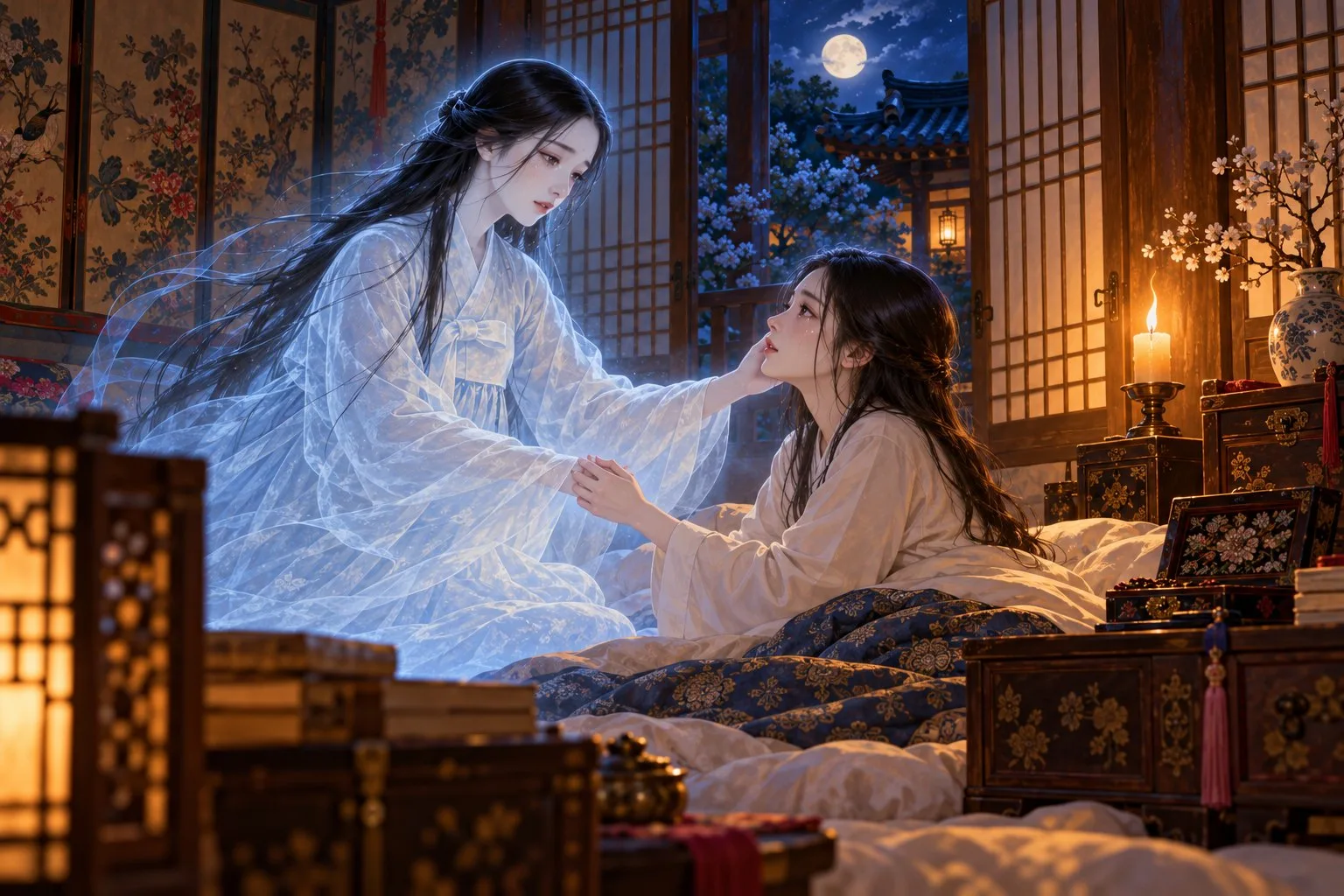
Hongryeon woke in tears. She learned from Jangsoe where the pond lay, and one night she slipped out of the house and found her way there. She stood on the bank, called her sister’s name, and threw herself into the water to be with her.
A blue bird, some tellers say, flew ahead of her through the trees and showed her the way. When she reached the water, the moon was shining on it, and everything was very still.
For days she said nothing. She did her chores and ate what she was given and kept her head down, and her stepmother thought she had been cowed at last. But at night Hongryeon lay awake listening to the wind, and thinking about the pond in the hills.
From then on, people said, the sound of weeping rose from that pond day and night.
The magistrates of Cheolsan
The sisters’ souls could not rest. They had died with a terrible wrong upon them, and no one in the world of the living knew the truth. So they went to the one person whose duty it was to put wrongs right: the magistrate of Cheolsan.
But when the new magistrate saw two pale girls in white standing by his bed in the middle of the night, he died of fright on the spot. So did the next magistrate, and the next. Soon no official in the kingdom would accept the post of magistrate of Cheolsan, and the town was left without anyone to govern it.
At last a man named Jeong Dong-u volunteered. He was not afraid. On his very first night in Cheolsan, the two sisters appeared before him, and instead of fainting, he spoke to them gently and asked what they wanted. Weeping, Janghwa and Hongryeon told him their story and begged him to clear their names.
His friends begged him not to go. His servants packed his things with trembling hands. But Jeong Dong-u said that a town without justice was worse than a town with ghosts, and that if the dead had something to say, someone ought to listen.
The next day the magistrate summoned Bae and Lady Heo. They lied smoothly. Janghwa, they said, had drowned herself out of shame, and Hongryeon had run away. Lady Heo even produced the “proof” she had hidden in Janghwa’s bed. The magistrate, uncertain, let them go.
That night the sisters came to him again. “Cut open the thing she showed you,” they said, “and you will see.” In the morning he did, and inside he found that it was nothing but a rat, stuffed with its own droppings. The stepmother’s trick was exposed. Lady Heo was condemned to death for her crime and Jangsoe punished with her. Bae, the foolish father, was sent home.
Then Jeong Dong-u went to the pond, had the sisters’ bodies lifted from the water and gave them a proper burial, with a stone to honour their names. That night they appeared to him one last time, not weeping but smiling, to thank him. They told him he would rise high in the king’s service, and he did.
The sisters return
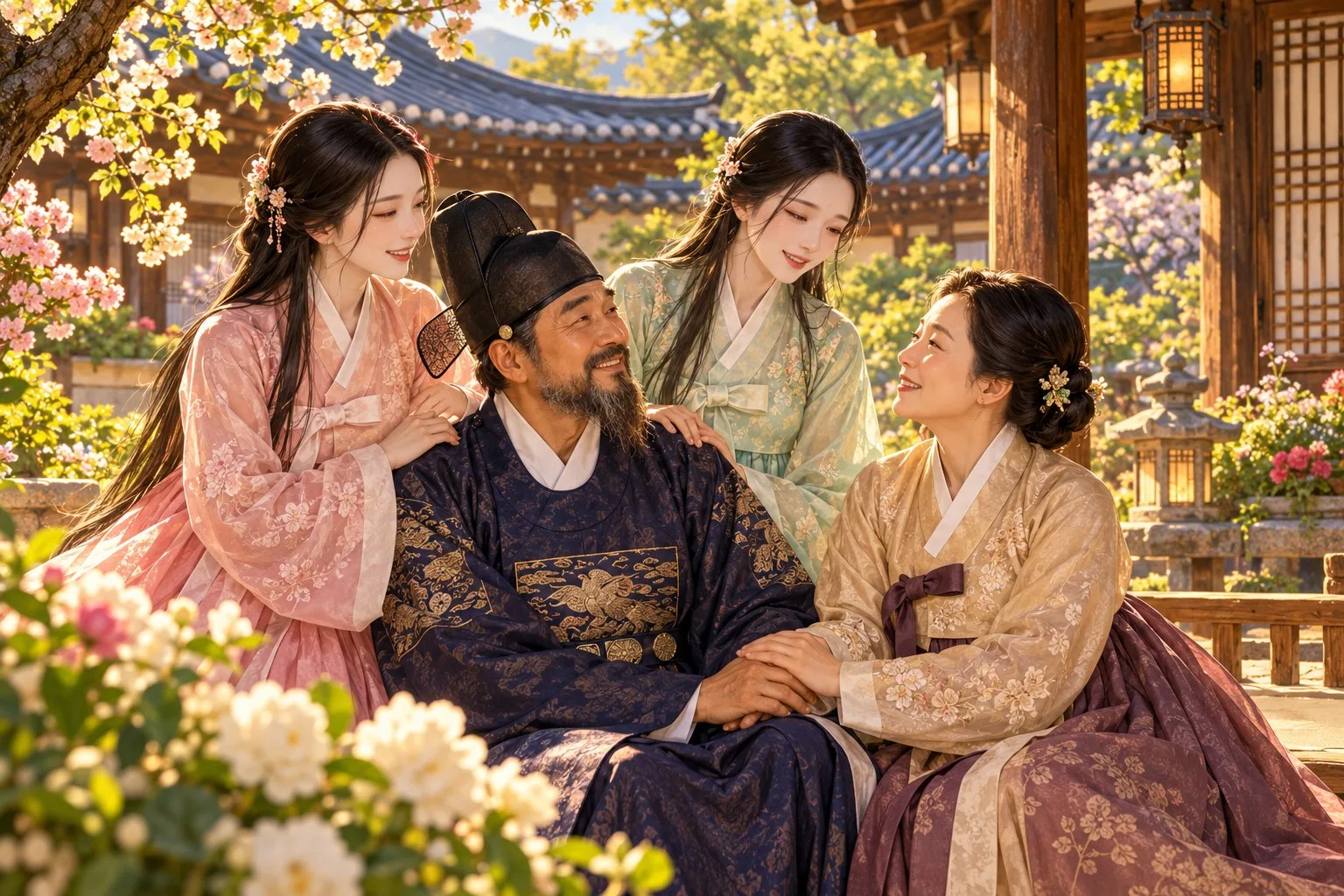
Some time later, Bae married a third time, a kind woman named Lady Yun. One night his two lost daughters came to him in a dream. The Lord of Heaven, they said, had decided that they should be his daughters again, to live out the life that had been stolen from them.
Lady Yun dreamed that she was given two flowers, and she gave birth to twin girls. Remembering the dream, Bae named them Janghwa and Hongryeon. This time they grew up loved and protected. When they were grown, they married twin brothers from a good family in Pyeongyang, had children of their own and lived long, happy lives.
A ghost story that was almost true
The early Classical Chinese version of the tale names its magistrate Jeon Dong-heul, a real seventeenth-century official, and says he really did investigate the deaths of two sisters in Cheolsan. His family kept the story in their records for generations. Whether the ghosts were part of the original case, no one can say, but it shows how closely the tale was tied to real places and real people.
Talk about it
Who do you think is most to blame for what happened: the stepmother, the father or someone else? Why did the earlier magistrates die, and why did Jeong Dong-u survive? And why do you think the storytellers gave the sisters a second life at the end?
Words to know
Janghwa (장화) means “rose” and Hongryeon (홍련) means “red lotus”. A busa (부사), or magistrate, was the official in charge of a town. A wongwi (원귀) is a ghost who died with an unresolved wrong. Han (한) is the deep, unhealed grief and sense of injustice that keeps such a ghost from resting.
Where this story comes from
Janghwa Hongryeon jeon (장화홍련전, The Tale of Janghwa and Hongryeon) is a classic Korean novel of the Joseon dynasty by an unknown author. The Encyclopedia of Korean Culture explains that it survives in many handwritten, woodblock and printed versions, in Classical Chinese, in Korean and in a mix of both. One of the earliest, written in 1818 by Bak In-su at the request of a descendant, says the story is based on a real case: in the seventeenth century, an official named Jeon Dong-heul, serving as magistrate of Cheolsan in Pyeongan province, is said to have solved the deaths of two sisters, the daughters of a local gentleman named Bae, caused by their stepmother's plotting.
The versions end in four different ways. In some, the truth comes out and the stepmother is punished. In others, she is then sent by King Yeomra through the hells. In a third group, the sisters come back to life and Janghwa marries the magistrate. In the most popular Korean-language version, followed here, the sisters are reborn as twins to their father and his new wife. In some versions a tiger punishes the stepmother's son and a blue bird leads Hongryeon to her sister, details scholars connect with shamanic beliefs. The story has been filmed many times, from silent films of the 1920s to the 2003 horror film A Tale of Two Sisters.
What it means
On the surface this is a story about a wicked stepmother, and older readers took it that way: the cruel woman is punished and the good daughters are rewarded. But the Encyclopedia of Korean Culture points out that the stepmother is not the only one to blame. The girls' father, Bae, believes every lie he is told, never protects his daughters and is let off at the end. Many modern readers see the tale as a portrait of a household falling apart because no one in it tried to hold it together, and some scholars have even written in defence of the stepmother, trapped in a family where her own place was never secure.
It is also one of the great Korean ghost stories, and it shows what Korean ghosts usually want. Janghwa and Hongryeon do not haunt the living for revenge. They come to be heard. The magistrates who die are not killed by the ghosts; they die of their own fear. The hero is simply the first official brave enough to sit still and listen. In Korean tradition, a ghost is someone with han, a wrong that has never been set right, and the story ends only when justice is done and the sisters are properly buried and honoured.
Sources & further reading
Retold from the summary of the Korean-language version of Janghwa Hongryeon jeon in the Encyclopedia of Korean Culture entry "장화홍련전". Some details of the stepmother's trick have been softened for younger readers. It is an English adaptation, not a translation.
- Encyclopedia of Korean Culture · 장화홍련전 (The Tale of Janghwa and Hongryeon) ↗
- Encyclopedia of Korean Culture · 귀신 (gwisin) ↗
Illustrations are imaginative interpretations, not historical records. Read our editorial policy.