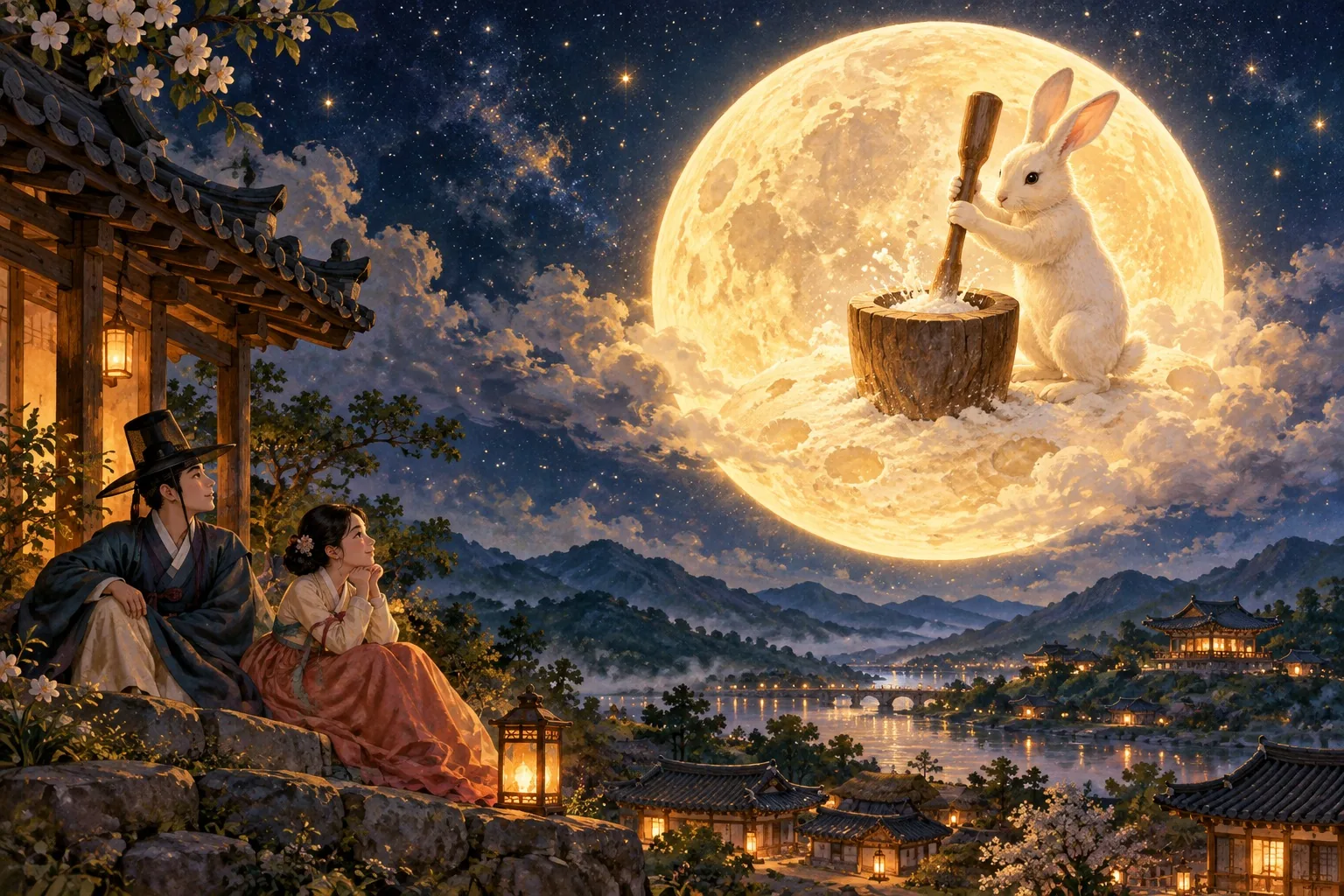
On the night of a full moon, a Korean grandparent might point up at the sky and ask a child what they can see. Not a man in the moon, but a rabbit. The dark patches on the moon’s face, Koreans say, are a rabbit standing beside a mortar, pounding away with a long wooden pestle under a great tree. This is the oktokki (옥토끼), the jade rabbit, also simply called the daltokki, the moon rabbit. It is one of the gentlest creatures in Korean folklore and one of the oldest, and almost every Korean child grows up singing about it.
What is the rabbit pounding?
Ask today and most people will tell you the rabbit is making tteok, rice cakes, the way families once pounded steamed rice in a mortar before a holiday. That is the version in picture books and on the packaging of autumn sweets, and it fits nicely with Chuseok, the harvest festival held under the full moon.
The older answer is stranger and more magical. In the poems of Korea’s scholars, the jade rabbit lives in the moon palace, Gwanghangung (광한궁), and what it pounds in its mortar is the elixir of immortality. The National Folk Museum of Korea’s encyclopedia collects several examples. The Goryeo writer Yi Gyu-bo, in the thirteenth century, imagined crossing a magpie bridge into the moon palace to trim the moon’s tree. The scholar Yi Saek, a century later, wrote that the jade rabbit seemed to be secretly watching him sigh. The Joseon official Gyeong Seom, sailing to Japan as an envoy in the early 1600s, wrote that “the medicine the jade rabbit pounded overflows my cup”, and the later poet Yun Gi wrote of Hang-a, the moon goddess known in China as Chang’e, who “stole the magic elixir and fled into the moon palace”.
So the moon in these poems is a whole little world: a palace, a goddess who ran away with a forbidden medicine, a tree, and a hard-working rabbit making more of the elixir that lets the moon’s people live forever.
A legend older than the poems
Here is a curious thing. The encyclopedia points out that the jade rabbit legend was never handed down in Korea as a full spoken folktale with a plot and characters. Instead, it survives as an image: a set of ideas so familiar that poets could mention “the jade rabbit” or “the rabbit’s medicine” and every reader would understand.
And that image is very old. A wall painting in the Gaemachong tomb, a Goguryeo tomb from around the fifth century, already shows the rabbit with its mortar inside the moon, which tells us the idea was known on the Korean peninsula well over a thousand years ago. Joseon folk painters kept painting it too. One nineteenth-century minhwa, described by the Northeast Asian History Foundation, shows a white moon rising beyond a tree while a rabbit below pounds medicine in its mortar.
Where the moon rabbit came from
The moon rabbit was never only Korean. It belongs to a family of moon stories shared across East Asia, and in Japan and China people also see a rabbit in the moon. The Northeast Asian History Foundation notes that the first written mention of a rabbit in the moon comes from the Chuci, an ancient Chinese poetry collection, in a poem by Qu Yuan that asks, almost puzzled, what the moon gains by keeping a rabbit in its belly. Some scholars trace the idea back even further, to India. During the Han dynasty in China, it combined with the story of the goddess who escaped to the moon with the elixir of immortality, and the rabbit got its job: pounding medicine.
Korea took this shared image and made it its own. In Korean poetry the rabbit is jade-white and quietly companionable, a fellow watcher of the night, and in Korean homes it slowly swapped its medicine for rice cakes.
The tree that isn’t quite the tree
Korean tellings always put a tree beside the rabbit, usually called the gyesu namu (계수나무). Today that name refers to the katsura tree, but the encyclopedia explains a small mix-up. The katsura was only brought to Korea from Japan in the 1920s, and because the Japanese write its name with the character 桂, it was given the Korean name gyesu. But the old poems’ “gyesu” meant a different tree with the same character, an osmanthus with sweet-smelling flowers, which came from China. So when you read about the moon’s gyesu tree in an old poem, picture fragrant osmanthus, not the katsura in a modern park.
A rabbit with magic powers
The jade rabbit’s link to the elixir of life gave rabbits a special glow in Korean legend. The encyclopedia mentions a legend called Tokkibawi, “Rabbit Rock”, from Sangju in North Gyeongsang province, in which a devoted son named Yi Gyeong-dae is told by a white-haired old man in a dream where to find a rabbit, and that rabbit saves his gravely ill father. The encyclopedia suggests that the “medicine of immortality” meaning of the moon rabbit spread into stories about filial children like this one.
That is quite different from the rabbit of Korean folktales. On earth, the Korean rabbit is a small, quick-witted trickster who talks its way out of being eaten by tigers and escapes from the Dragon King’s undersea palace with nothing but its brains. In the sky, it is calm, patient and a little sacred.
Read The Rabbit and the Dragon King →
“Bandal”, the song every Korean knows
The moon rabbit’s most famous home today is a children’s song. In 1924, the composer Yun Geuk-yeong wrote “Bandal” (“Half Moon”), one of the very first Korean children’s songs of the modern era. It pictures the half moon as a little white boat drifting across the Milky Way, carrying one gyesu tree and one rabbit, sailing without mast or oar towards the western land.
The encyclopedia notes that the song takes its picture straight from the jade rabbit legend. Written during the Japanese colonial period, it became a song of quiet longing, and generations of Korean children have learned it at school. Ask almost any Korean adult to sing it and they can.
Quick facts
The oktokki, or jade rabbit, is the rabbit Koreans see in the full moon, pounding with a mortar and pestle under a tree. In old poetry it pounds the elixir of immortality in the moon palace. In modern tellings it pounds rice cakes. The image appears in a fifth-century Goguryeo tomb painting, in Goryeo and Joseon poems and in Joseon folk paintings, and it is shared with China and Japan. The 1924 children’s song “Bandal” made the rabbit and its tree part of every Korean childhood.
Meet the bulgasari, the monster that eats iron →
Sources & further reading
- National Folk Museum of Korea · Encyclopedia of Korean Folklore and Traditional Culture · 문학 속 토끼 (the rabbit in literature) ↗
- National Folk Museum of Korea · Encyclopedia of Korean Folklore and Traditional Culture · 계수나무 ↗
- Northeast Asian History Foundation · 약방아 찧는 토끼 (the rabbit pounding medicine, a Joseon folk painting) ↗