In the old city of Songdo there lived a young man named Jeon Woochi who had learned the secrets of magic. He could change his shape into a bird or a beast or another man entirely. He could call up wind and clouds, ride on the air, and make things appear out of nothing. But he kept his powers hidden, and to his neighbours he seemed like any other quiet young scholar who spent too much time with his books.
Then came years of bad harvests. The rains failed in spring and came too heavily in autumn. Rice rotted in the fields. Along the coast, the sea flooded the paddies with salt. Jeon Woochi walked through the streets and saw people starving: children with hollow cheeks and swollen bellies, old people too weak to stand, families boiling tree bark to make soup. And all the while, behind high walls, the officials and nobles held feasts, and their storehouses were full.
Jeon Woochi stood outside one of those walls one evening, listening to the music and laughter inside, and he made up his mind.
“Magic that only hides is worth nothing,” he said to himself. “It is time I used it.”
The messenger from heaven
Not long afterwards, one morning, the king of Joseon was holding court in his palace. The ministers stood in their long rows in their robes of office, and the king sat on his throne beneath the painted screen of the sun and moon.
Suddenly the sky above the palace filled with clouds of every colour, red and gold and violet, rolling and glowing like sunrise. Music drifted down from somewhere high above, strange and beautiful, played on no instrument anyone had ever heard. The ministers gasped. Out of the clouds, borne gently on the wind, came a figure in robes that shone like moonlight, attended by heavenly servants holding banners and fans.
The whole court fell to its knees. The king himself stepped down from his throne and bowed his head to the ground.
“King of Joseon,” announced the shining figure, in a voice like a temple bell, “I bring you a command from the Jade Emperor, ruler of heaven. The Jade Emperor is building a new palace in the sky. For its roof, he requires a beam of pure gold from the kingdom of Joseon. Have it ready one month from today, and I will return for it.”
Then the clouds folded round him, and he was gone.
High above the city, hidden in the clouds he had called up, Jeon Woochi lay back on the soft grey billows and laughed until his sides ached. Then he grew serious again, and looked down at the palace roofs, and thought about the hungry people in the streets.
For a long time nobody moved. Then the court burst into a frenzy of whispers. The king was terrified. Who could refuse the Jade Emperor? He gave orders at once. Messengers galloped to every province. Gold was gathered from the royal treasury, from temples and noble houses, from rings and hairpins and bowls. The royal goldsmiths worked day and night at their furnaces, and at last an enormous beam of solid gold lay gleaming in the palace courtyard.
On the appointed day, the coloured clouds came again. The music played, the shining messenger descended, and with great ceremony the golden beam was raised up and carried away into the sky.
The king and his ministers bowed until the last cloud had vanished, very pleased with themselves for having served heaven so well.
Of course, the messenger was Jeon Woochi.
Feeding the poor
Far from the capital, Jeon Woochi broke the golden beam into pieces and sold it, a little here and a little there, to merchants in distant towns. With the money he bought rice: cartload after cartload of it, more rice than anyone in the provinces had seen in years. Then he gave it all away to the starving people of Joseon, filling every outstretched bowl.
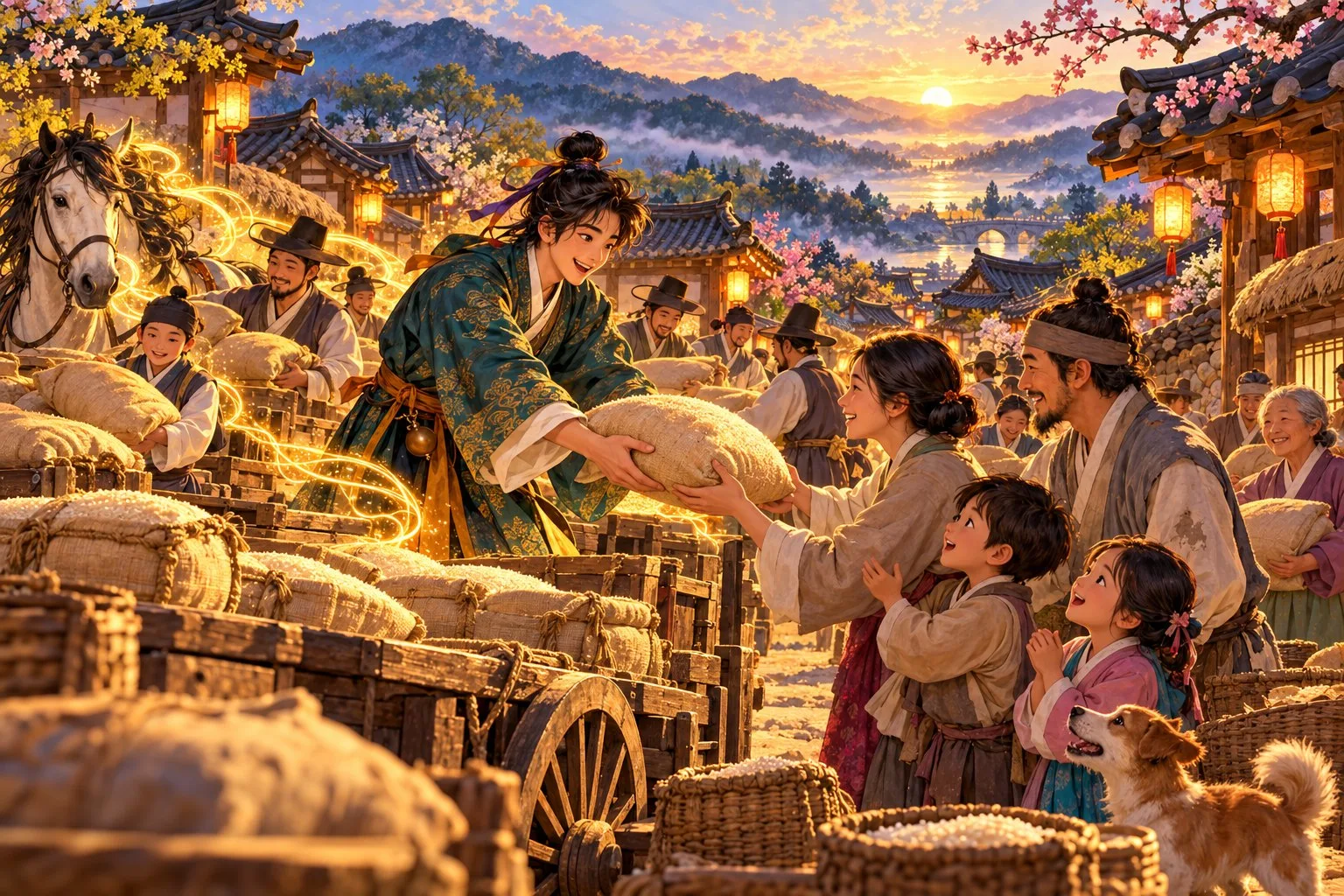
He made no secret of who he was or where the rice had come from. He wanted the king to know.
“This rice comes from the king’s own treasury,” he told the crowds. “It was always yours. You paid for it with your taxes and your hunger. I have only brought it back.”
When the king discovered that he had been tricked, he was furious. A heavenly messenger who turned out to be a scholar from Songdo! The whole court was a laughing stock. Soldiers came to arrest Jeon Woochi and dragged him in chains to the capital. But no prison could hold him. Once he turned into a bird and flew out through the bars. Once, when they were about to punish him, he drew a picture on the wall, stepped into it, and was gone. Every time they thought they had him, the guards were left staring at an empty cell.
For years after that, he wandered the country. Wherever he found a greedy official cheating the farmers, or a rich man bullying the poor, he played tricks on them until they gave back what they had taken. The people loved him for it. The government hated him.
Once, to everyone’s surprise, he gave himself up and offered to serve the king. He was given a low rank in the army, and when a band of rebels rose up in the provinces, he used his magic to help put them down. But at court, jealous officials whispered that a man with such powers must surely be plotting to take the throne for himself. Soon the court began to suspect him of treason, and Jeon Woochi had to flee once more.
The teacher on the mountain
As the years went by, Jeon Woochi grew proud. He had never met anyone whose magic could match his. He began to use his powers more and more for his own amusement, playing with the world as if it were a game, and he no longer stopped to ask whether his tricks did any good.
Then one day a friend of his fell in love with a young widow who did not want to marry again. Jeon Woochi decided to help. He would use his magic to bring her to his friend, whether she liked it or not. But as he set to work, he found his spells blocked by magic stronger than his own. For the first time in his life, someone had stopped him.
He followed the trail of that magic to a quiet mountain hermitage, the home of the great scholar Seo Gyeongdeok, whom people called Hwadam. Hwadam was an old man in a plain robe, reading by an open window.
Jeon Woochi challenged him to a contest of magic, sure that he would win. Whatever shape Jeon Woochi took, Hwadam took a stronger one. Whatever spell he cast, Hwadam quietly undid it. In the end Jeon Woochi stood panting in the courtyard, and bowed his head, and admitted defeat.
“You have great gifts,” said Hwadam gently, “perhaps the greatest I have ever seen. But you have used them carelessly, because no one ever taught you what they were for. Come with me.”
Jeon Woochi said nothing for a long time. He looked down at his hands, which had made gold beams and clouds and storms, and for the first time in his life, they looked small to him.
So Jeon Woochi followed Seo Hwadam deep into the mountains, to a place where no road went. There the two of them stayed, studying the Way. And they were never seen in the world of men again.

The real Jeon Woochi
Joseon writers told many strange stories about the real Jeon Woochi. He was said to have spat out mouthfuls of rice that turned into white butterflies, and to have climbed a rope into the sky to pick the peaches of heaven. One story claimed that after he died, he came back and borrowed a book of Du Fu’s poems from a living friend. And when his relatives opened his grave, they found nothing inside but an empty coffin. To those who knew Taoist lore, that meant he had not really died at all, but had shed his body and become an immortal.
Talk about it
Was Jeon Woochi a hero or a troublemaker? Is it right to trick a king if you use what you get to help people? Why do you think the story ends with him finding a teacher?
Words to know
Dosul (도술) means magic arts or Taoist sorcery. Seongwan (선관) is an official of heaven. Okhwang sangje (옥황상제) is the Jade Emperor, ruler of heaven. Hwadam (화담) is the pen name of the philosopher Seo Gyeongdeok.
Where this story comes from
Jeon Woochi (전우치) was a real person. The Encyclopedia of Korean Culture notes that he probably lived in the time of King Jungjong in the early sixteenth century, and several Joseon writers recorded strange stories about him. The miscellany Jibong yuseol calls him a scholar from Seoul who was skilled in illusions and could command spirits. The Eou yadam says he was jailed at Sincheon for bewitching people and died in prison, but when his relatives later dug up his grave to rebury him, the coffin was empty.
From these legends grew Jeon Woochi-jeon, a classical novel by an unknown author that survives in many different versions. The best-known one, retold here, has him trick the king with a golden beam, help the poor, run rings around the government, and finally submit to the philosopher Seo Gyeongdeok, known as Hwadam. In 2009 the story was turned into a hit Korean film.
What it means
The Encyclopedia of Korean Culture notes that the golden beam episode appears in every version of the novel, and that it mocks the authority of the king himself. Jeon Woochi's magic lets him break all the rules of Joseon society and turn its values upside down, much like his fellow outlaw hero Hong Gildong.
But readers have never agreed on whether he is a champion of the poor or just a show-off who enjoys his tricks. Some versions linger on his pranks and seem to admire them. Others treat his wild years as the foolishness of a gifted young man with no teacher, which ends only when Seo Gyeongdeok humbles him and takes him into the mountains to study properly.
Sources & further reading
Retold from the summary of the Sinmungwan edition of the novel in the Encyclopedia of Korean Culture entry "전우치전", with legends from the entry on Jeon Woochi. It is an English adaptation, not a translation.
- Encyclopedia of Korean Culture · 전우치전 (the tale of Jeon Woochi) ↗
- Encyclopedia of Korean Culture · 전우치 (Jeon Woochi) ↗
Illustrations are imaginative interpretations, not historical records. Read our editorial policy.