In the southeast of the Korean peninsula, long ago, there was no king. The land was shared by six villages, each with its own chief, and the six chiefs did their best to keep the peace. But one spring day they gathered on a riverbank and agreed that it was not enough. "Our people have no ruler," they said. "They do as they please. Let us find someone with true virtue to be our king."
It was the first day of the third month, the Samguk Yusa says, and the chiefs had brought their sons and their families with them to the bank of the Alcheon river. The water ran clear and cold from the hills, the plum trees were just coming into flower, and everyone could feel that something important was about to happen, though no one could say what.
The purple egg
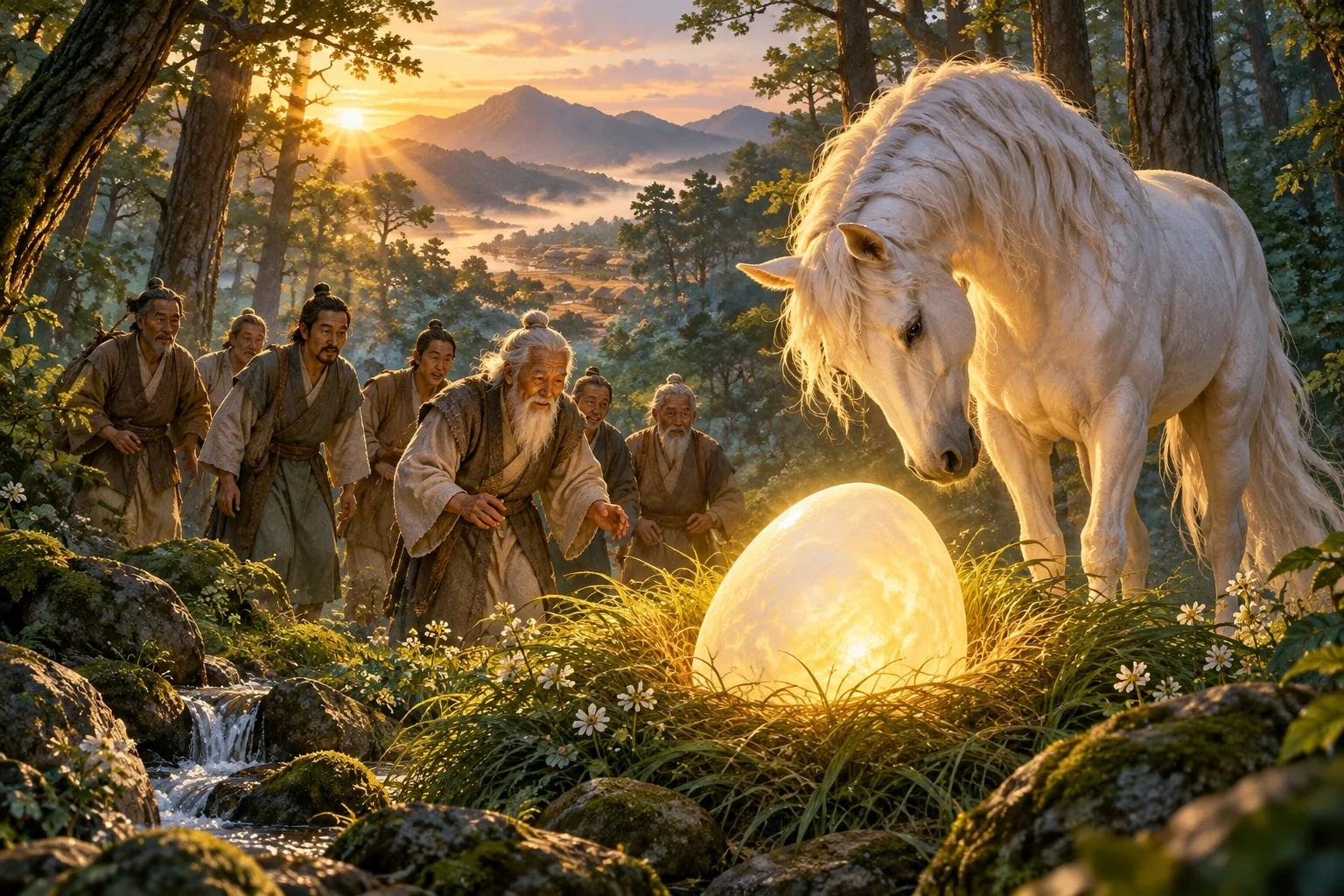
The six chiefs climbed to a high place and looked out to the south. At the foot of a mountain, beside a well called Najeong, they saw a strange light, like lightning, stretching down from the sky to the ground. In the light, a white horse was kneeling, as if bowing to something.
The chiefs hurried down the mountain. When they reached the well, they found a large purple egg lying on the ground. The white horse looked at them, gave a long cry and rose up into the sky, and was gone.
They ran so fast that the oldest of them had to be helped along by the others, and nobody spoke a word the whole way down.
The chiefs broke open the egg, and inside was a baby boy, perfectly formed and beautiful. They bathed him in a spring, and his whole body shone with light. Birds and beasts danced together, the earth trembled, and the sun and the moon shone clear and bright. They named him Hyeokgeose, which means “the one who brightens the world”. And because the egg was round like a gourd, which in their language was called bak, they gave him the family name Bak.
On the very same day, beside another well called Aryeong, a dragon appeared and a baby girl was born from under its left arm. She was lovely, except that her lips were shaped like a chicken’s beak. But when the people bathed her in a stream, the beak fell away. They named her Aryeong, after the well where she was born.
The stream where she was bathed, people said, was called Balcheon ever after, the Stream Where the Beak Came Off. It is the kind of detail that only a very old story keeps, a joke and a wonder at the same time, told by people who loved their first queen enough to tease her a little.
The people built a palace and raised the two holy children together. When they were thirteen, Hyeokgeose became king and Aryeong became his queen. Their kingdom was called Seorabeol, and later it became known as Silla. Hyeokgeose ruled for sixty-one years. Then, the old book says, he rose up into heaven.
Six golden eggs
To the west, near the mouth of a great river, there was another land with no king. Nine chiefs governed its people. One spring, at the time of the year’s purifying festival, a strange voice called out from a hill named Gujibong, the Tortoise Peak.
“Is anyone there?” said the voice.
“We are here,” the nine chiefs answered.
“Where am I?”
“Gujibong.”
“Heaven has commanded me to come down here, to found a new kingdom and be its king,” said the voice. “Dig the earth at the top of the peak, and sing as you dig, and dance for joy, and you will welcome your king.”
So the nine chiefs and their people dug and danced and sang a song that is still remembered:
Tortoise, tortoise, show your head! If you do not show it, we will roast you and eat you.
As they sang, a purple rope came down from the sky until it touched the ground. At its end hung a red cloth, and wrapped in the cloth was a golden box. Inside the box were six golden eggs, round as the sun.
The people bowed again and again. They carried the box home and kept it safe, and the next morning, when they opened it, the six eggs had become six baby boys. The children grew astonishingly fast. The first to hatch was named Suro, and he became king of Garak, later called Geumgwan Gaya. The other five boys became the kings of the five other Gaya kingdoms.
Suro grew so fast, the old record says, that in just over ten days he was nine feet tall, with a face like a dragon’s and eyebrows of eight colours. On the full moon of that month he took the throne, and the people built him a palace of simple buildings with thatched roofs, because he told them he did not want them to be overworked.
Years later, his chiefs urged him to choose a queen from among their daughters. Suro refused. Heaven, he said, would send him his queen. And sure enough, one day a ship with red sails came over the sea from the southwest, carrying a princess named Heo Hwang-ok, who said she had come from a faraway kingdom called Ayuta because her parents had been told in a dream to send her to the king of Garak.
The boy from the sea
The third king came not from the sky but from the sea. In the days of Silla’s second king, an old woman who lived by the shore saw a flock of magpies flying over the water, crying and crying. She went to look and found a boat, and in the boat was a large chest. When she opened it, there was a handsome boy inside, along with treasures and servants.
After she had looked after him for seven days, the boy spoke. “I come from the land of Yongseong,” he said. “I was born from an egg laid by the queen, and because of that I was thrown away, and the sea carried me here.” He became known as Talhae.
Talhae was not only strange. He was clever. Looking around the capital for a place to live, he spotted a fine house on a hill, but it belonged to a nobleman named Hogong. So one night Talhae secretly buried a whetstone and some charcoal beside the house. In the morning he went to the officials and said, “That house belonged to my ancestors. My family were blacksmiths. While I was away, Hogong moved in and took it.” When they dug where Talhae told them to, they found the whetstone and charcoal, the tools of a blacksmith, and the house was given to him.
Hogong could only stand there with his mouth open. He had lived in that house for years, and he had never seen a whetstone in his life.
The king heard of this and thought Talhae must be a very wise young man. He gave him his eldest daughter as a wife, and in time Talhae became the fourth king of Silla.
Some say that, before that, Talhae once sailed to Gaya and challenged King Suro for his throne. The two of them fought a battle of magic, changing shape again and again: when Talhae became a hawk, Suro became an eagle, and when Talhae became a sparrow, Suro became a falcon. In the end Talhae admitted he was beaten and sailed away. The egg-born kings, it seems, were evenly matched.
Places you can still visit
Many places from these stories are real. The site of Najeong, the well where the purple egg was found, is in Gyeongju, the old capital of Silla. Gujibong, the hill where the six golden eggs came down, is in Gimhae, near Busan, not far from the tomb traditionally said to be King Suro’s. And the families who claim descent from these kings, the Bak, the Gimhae Kim and the Seok, still trace their ancestry back to the eggs.
Talk about it
Why do you think so many Korean kings were said to come from eggs? Was Talhae’s trick with the whetstone and charcoal clever or dishonest, and why might the king have admired it? And what do you think the song to the tortoise was for?
Words to know
Nansaeng sinhwa (난생신화) means “egg-birth myth”. Bak (박) is a gourd, and the family name Bak, often written Park. Silla (신라) and Gaya (가야) were ancient kingdoms in the south of Korea. Gujibong (구지봉) is the Tortoise Peak, and the Gujiga (구지가) is the song sung there.
Where this story comes from
Korea has more founding myths with egg births than any other kind. The Encyclopedia of Korean Culture lists King Dongmyeong (Jumong) of Goguryeo, King Talhae and Bak Hyeokgeose of Silla, and King Suro of Gaya among them, and notes that while egg-birth myths are also found in Southeast Asia, the Korean ones are unusually detailed and well preserved.
The three tales here come from the two great early histories. Bak Hyeokgeose's story is in both the Samguk Sagi (1145) and the Samguk Yusa (1280s). Talhae's is told in both as well. Kim Suro's comes from the Garakgukgi, a record of the Gaya kingdom compiled in the Goryeo period, which survives only in the shortened form Iryeon copied into the Samguk Yusa. It is the only written source we have for Gaya's own history. Traditional dates put Hyeokgeose's founding of Silla in 57 BCE and Suro's founding of Gaya in 42 CE.
What it means
Why eggs? The encyclopedia explains that every egg-born founder is ultimately linked to heaven. Some eggs, like Hyeokgeose's and Suro's, come straight down from the sky in a blaze of light, a sign that the child inside is a son of heaven or of the sun. Others, like Jumong's and Talhae's, are laid by a human mother, rejected and thrown away, and only later recognised as sacred. Either way, the egg says that this ruler is a brand-new, holy life, not just another chief's son.
The stories also show how kingdoms were born from many villages. In both Silla and Gaya, the land is already run by several village chiefs, six in Silla and nine in Gaya, who gather and ask heaven for a king. The encyclopedia points out that the Suro story records the words of a god speaking from the sky, and the people singing and dancing to welcome him, much like the shaman's rites that still welcome gods into Korean villages today. Talhae, meanwhile, adds something different: he comes from the sea, not the sky, and he wins his place by being cleverer than everyone else.
Sources & further reading
Retold from the outlines in the Encyclopedia of Korean Culture entries "박혁거세신화", "김수로왕신화", "석탈해신화" and "난생신화", based on the Samguk Yusa and Samguk Sagi. It is an English adaptation, not a translation.
- Encyclopedia of Korean Culture · 박혁거세신화 (the Bak Hyeokgeose myth) ↗
- Encyclopedia of Korean Culture · 김수로왕신화 (the Kim Suro myth) ↗
- Encyclopedia of Korean Culture · 석탈해신화 (the Seok Talhae myth) ↗
- Encyclopedia of Korean Culture · 난생신화 (egg-birth myths) ↗
Illustrations are imaginative interpretations, not historical records. Read our editorial policy.