In the town of Namwon, in the south of Korea, spring had come. The willows along the river were turning green, the azaleas were blooming on the hills, and on the fifth day of the fifth month, the festival of Dano, the whole town was out of doors. Young women in bright skirts rode swings hung from the tall trees, soaring higher and higher until their ribbons streamed in the wind.
Up in Gwanghallu, an elegant pavilion beside the river, a young man was looking out over the view. His name was Yi Mong-ryong. He was the son of the new magistrate of Namwon, sixteen years old, clever and bored, and he had escaped his studies for the afternoon with his servant, Bangja.
Then he saw her. Across the green meadow, a girl in a red skirt was flying back and forth on a swing beneath a willow, so high that she seemed to touch the clouds. Mong-ryong forgot about the view.
Her braid flew out behind her. Her laughter carried across the meadow, clear as a bell. Each time the swing reached the top of its arc, she seemed to hang there for a heartbeat against the blue sky before she swooped down again, and Mong-ryong found he was holding his breath.
“Who is that?” he asked.
“That’s Chunhyang,” said Bangja. “Daughter of Wolmae, who used to be a gisaeng. She’s the most beautiful girl in Namwon, and the most stubborn, too.”
A spring promise
Mong-ryong sent Bangja to fetch her. Chunhyang refused to come. A respectable girl, she sent back, did not run to a young man just because he whistled. Mong-ryong, not used to being refused, was more fascinated than ever. That evening he went to her house himself.
Bangja trotted behind him, grumbling that the young master would get them both into trouble. Mong-ryong did not hear a word. He was rehearsing what he would say, and discarding it, and rehearsing again.
Wolmae welcomed the magistrate’s son warily. She knew how these stories usually ended for girls like her daughter: a young nobleman amused himself for a season, then went back to Seoul and forgot. But Mong-ryong spoke to Chunhyang with real respect, and she found him far more sincere than she had expected. They talked late into the night, and fell deeply in love. Mong-ryong swore he would marry her, and to prove it he wrote out his promise and gave it to her.
For a while they were perfectly happy.
They met in the evenings in Wolmae’s little garden, under the peach tree. Mong-ryong recited poems to her, and Chunhyang, who had been taught to read and write by her mother, answered with poems of her own that were better than his. He teased her, and she teased him back, and they made plans for a future that seemed certain and very near.
The parting
Then the blow fell. Mong-ryong’s father was promoted to a post in Seoul, and the family had to leave Namwon at once. A magistrate’s son could not openly bring the daughter of a gisaeng home as his bride. Mong-ryong had to go, and Chunhyang had to stay.
They said goodbye at the edge of town, both in tears. Chunhyang gave him a ring and he gave her a mirror, and they promised each other that nothing would break their bond. “Study hard,” she told him. “Pass the examination. And come back for me.” Then he rode away up the road to Seoul, and she watched until the dust had settled.
The new magistrate
A new magistrate came to Namwon, a man named Byeon Hak-do. He cared nothing for the people. He cared about money, feasting and pretty women. Almost the first thing he did was demand to see Chunhyang, whose beauty he had heard about even in Seoul.
Chunhyang was dragged before him. Byeon ordered her to become his companion and serve him.
She knelt in the courtyard of the magistrate’s office, among the guards and the clerks and the staring servants, with her hands folded and her eyes lowered, but her back perfectly straight.
“I have already given my word to someone,” Chunhyang said. “I will not break it.”
Byeon laughed. The daughter of a gisaeng had no right to make promises, he said, and no right to refuse a magistrate. Chunhyang lifted her chin and answered him to his face. A faithful heart, she said, did not change with a person’s rank, and a governor who forced himself on the people he ruled was no better than a criminal.
The magistrate turned purple with rage. He had her beaten in the courtyard, in front of everyone. With each blow, the old song says, Chunhyang cried out a verse of defiance, and the watching townspeople wept. Then he had her locked in prison with a heavy wooden cangue around her neck, and announced that on his birthday, at the height of the feast, she would be put to death.
The beggar at the gate
Far away, Mong-ryong had studied day and night. He passed the royal examination at the top of the list, and the king, impressed, appointed him an amhaeng eosa, a secret royal inspector, sent in disguise to the provinces to find and punish corrupt officials. He chose the road to Namwon.
Dressed in rags like a beggar, he travelled south, and everywhere he went he heard the farmers cursing the new magistrate of Namwon and pitying the brave girl in his prison. When he reached Chunhyang’s house, Wolmae looked at the filthy, tattered young man and burst into tears. “So this is how you come back,” she wailed. “Our last hope, and you’re a beggar!”
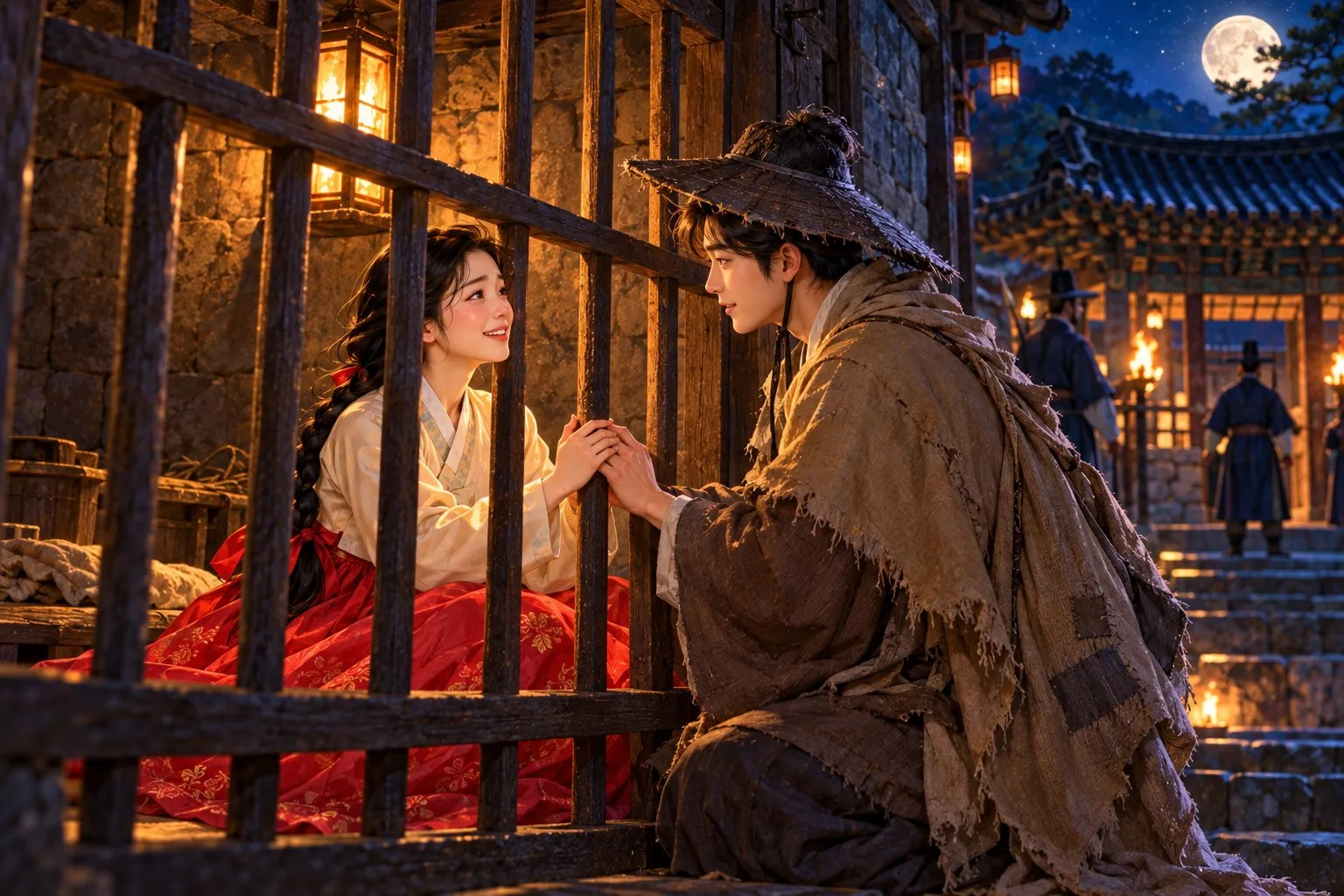
That night he went to the prison. Chunhyang, battered and weak, saw him through the bars, recognised him at once and did not care about his rags. “If I die tomorrow,” she said, “bury me properly, and come to my grave sometimes.” Mong-ryong could hardly speak.
He reached through the bars and took her thin hand in his. “Do not give up,” he said at last, very quietly. “Not yet. Tomorrow may be different from what you think.” Chunhyang only smiled at him sadly. She thought he was trying to comfort her.
The inspector arrives
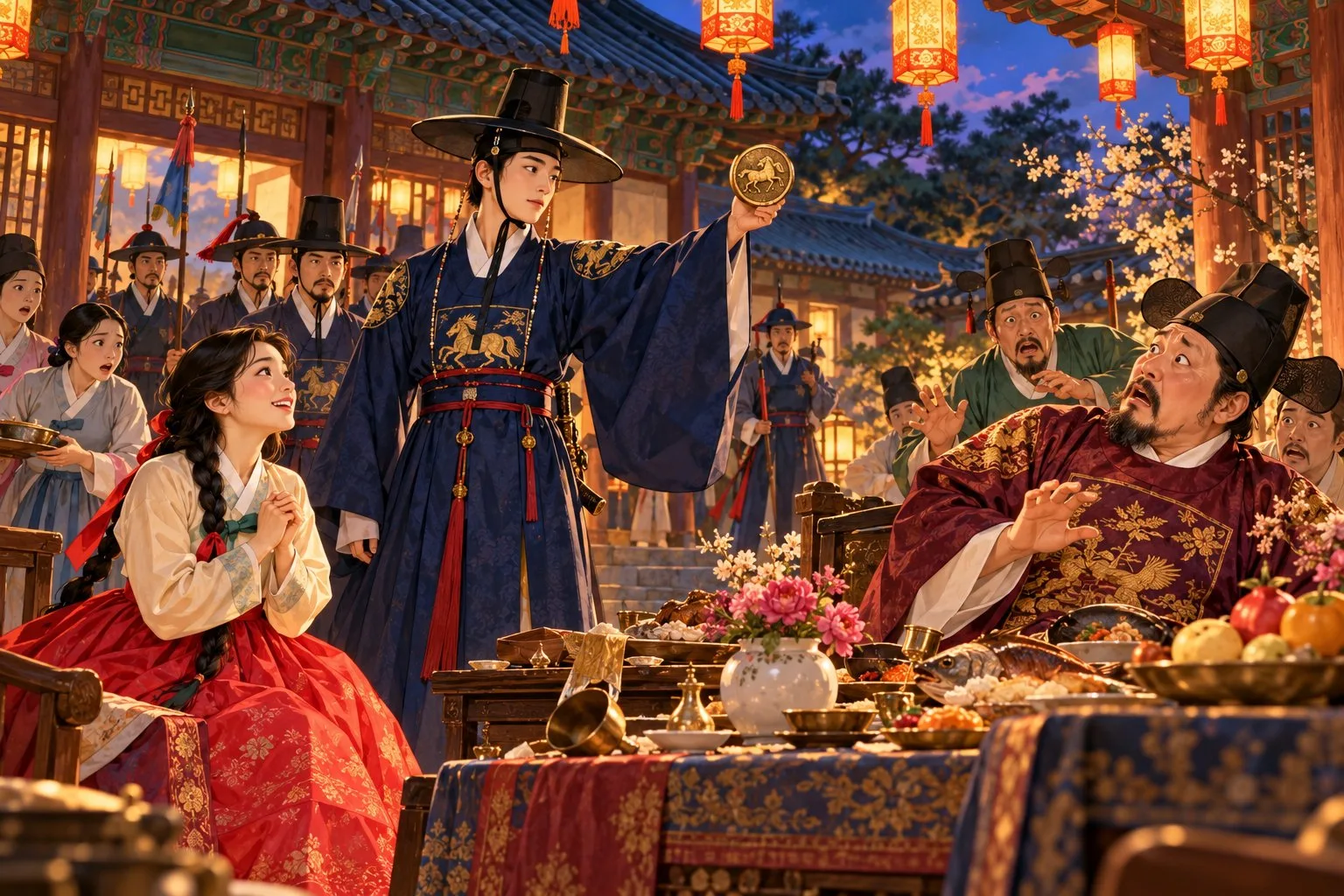
The next day, the magistrate’s birthday feast was in full swing. Officials from all the nearby towns were drinking, eating and laughing. A ragged beggar pushed his way in and asked for a seat. They mocked him, gave him a scrap of food, and, as a joke, told him to compose a poem.
He picked up a brush and wrote:
The fine wine in golden cups is the blood of a thousand people.
The fine food on jade plates is the fat of ten thousand people.
When the candle tears fall, the people’s tears fall.
Where the songs are loudest, the cries of resentment are loudest.
The guests who could read it went pale and began slipping away. Then, outside the gate, voices roared: “Amhaeng eosa chuldo! Make way for the royal inspector!” Officers poured into the courtyard. The magistrates scattered, hiding under tables and tumbling over each other, and Byeon Hak-do was seized and stripped of his office on the spot.
Then the inspector sent for the prisoner who was to die that day. Chunhyang was brought in, too weak to lift her head. “Will you serve me?” the inspector asked her. “No,” she whispered. “Not you, nor anyone.” He held out the ring she had given him long ago. Chunhyang looked up and saw Mong-ryong’s face.
He took her to Seoul as his true wife, and they lived together for the rest of their long lives.
Namwon today
Gwanghallu, the pavilion where the lovers first met, still stands in Namwon, in North Jeolla province, surrounded by ponds and a stone bridge said to represent the magpie bridge of the heavens. Every year the town holds a Chunhyang festival around Dano, and visitors can see a shrine to Chunhyang and the swing beneath the willows.
Talk about it
What gives Chunhyang the courage to refuse the magistrate? Why do you think Mong-ryong came back disguised as a beggar instead of revealing himself at once? And what is the inspector’s poem really saying?
Words to know
Dano (단오) is the spring festival on the fifth day of the fifth lunar month. A gisaeng (기생) was a trained female entertainer, attached to the government and of low social status. An amhaeng eosa (암행어사) was a secret royal inspector sent in disguise to expose corrupt officials. Gwanghallu (광한루) is the pavilion in Namwon where the lovers met.
Where this story comes from
Chunhyang jeon (춘향전, The Tale of Chunhyang) is the best-loved love story in Korean literature. The Encyclopedia of Korean Culture describes it as a pansori-based novel of unknown authorship from the Joseon dynasty, and notes that more than three hundred versions survive, including the Jeonju woodblock edition Yeollyeo Chunhyang sujeolga, the Seoul lending-library manuscript Namwon gosa, the Classical Chinese Gwanghallu-gi and the early printed Okjunghwa. The pansori Chunhyangga was probably being sung by the early eighteenth century; a poem retelling it was written in 1754.
Scholars believe the story grew from several older tales, including legends of a young official who returns in disguise as a secret royal inspector, Joseon anecdotes about romances between young noblemen and gisaeng (female entertainers), and a Namwon legend about a woman who died longing for a young gentleman. The versions differ especially over who Chunhyang is: in some she is a gisaeng, bound to serve the local government, and in others she is not, which changes how bold her defiance appears. The retelling here follows the familiar outline. Chunhyang has since become an opera, a ballet, musicals, more than a dozen films and countless TV dramas and webtoons.
What it means
The traditional reading praises Chunhyang's faithfulness: she keeps her promise to one man even under torture. But many readers find something more radical in her. She is the daughter of a gisaeng, near the bottom of Joseon society, and the new magistrate believes he has every right to command her. Chunhyang says no to the most powerful man in Namwon, publicly and repeatedly, and is willing to die rather than obey. The Encyclopedia of Korean Culture notes that in some versions she is a truly 'problematic individual', openly at odds with the rules of her world, while later versions soften her into a more obedient heroine.
The story is also a satire of corrupt officials. Byeon Hak-do is greedy, cruel and vain, and the ordinary people of Namwon, from the prison guards to the farmers in the fields, curse him behind his back. When the secret inspector bursts into his birthday feast, the audience cheers not only for the lovers but for justice against the abuse of power.
Sources & further reading
Retold from the outline of Chunhyang jeon in the Encyclopedia of Korean Culture entry "춘향전", following the common shape of the Jeonju edition. It is an English adaptation, not a translation.
- Encyclopedia of Korean Culture · 춘향전 (The Tale of Chunhyang) ↗
- Encyclopedia of Korean Culture · 춘향가 (Chunhyangga) ↗
Illustrations are imaginative interpretations, not historical records. Read our editorial policy.