Long ago, a young man lived beside the Geum River, where it bends past the town we now call Gongju. He fished the river and cut wood in the hills, and in the evenings he sat by the water with the other young men of the village, watching the ferry boats go back and forth.
Across the river rose a mountain called Yeonmisan, thick with pine and oak. The villagers did not go there often. They said the forest was deep and the paths were easy to lose, and that bears lived in the high places. But firewood was scarce on the village side that year, and one autumn morning the young man rowed across, tied up his boat and climbed into the trees with his axe.
He worked all day. The wood was good and plentiful, and he went higher and higher, further and further from the river. When at last he tied up his bundle and turned for home, he found that the light was fading, and none of the trees looked familiar.
Lost on Yeonmisan
He walked one way and then another. He called out, but only his own voice came echoing back to him. The path he thought he had followed disappeared among roots and rocks. Night came down, black and cold, and an owl began to call somewhere above him.
Then, in the darkness, something moved between the trunks. Something huge. He heard branches snap and smelled a heavy, wild smell. Before he could even lift his axe, a great she-bear rose up on her hind legs in front of him, taller than a man, her eyes catching what little light there was.
He tried to run, but she was far faster. She seized him in her powerful arms, swung him up onto her shoulder like a sack of rice, and carried him off, up and up the slopes of the mountain, through places no person had ever walked.
At last she stopped at the mouth of a cave, deep in a fold of the rock, and carried him inside. She set him down on a bed of dry leaves at the back of the cave. He crouched there, shaking, waiting for her to kill him.
But she did not. Instead, as he watched, the bear began to change. Her shaggy fur seemed to melt away. Her huge shape grew smaller and softer. And where the bear had been, there stood a young woman with long dark hair and dark, watchful eyes, gazing at him.
Life in the cave
The bear woman did not harm him. In the morning she went out and came back with fish from the mountain streams, wild berries, chestnuts and honey, and laid them in front of him. She did not speak much, but she sat beside him while he ate, and when he shivered, she brought more leaves and covered him.
Sometimes, in the firelight, he caught her looking at him with an expression he did not understand, half fierce and half afraid, as if she were holding something precious that might fly away.
She cared for him tenderly. But she never let him go. Whenever she went out, she rolled a great boulder across the mouth of the cave, so heavy that he could not move it however hard he pushed. Whenever she came back, she looked first to see that he was still there.
Days became weeks, and weeks became months. The snow came and went. The young man learned the sounds of the mountain and the smell of the cave. Sometimes, in the long evenings, the bear woman sat close to him and watched the fire, and he found that he was no longer afraid of her.
In time the bear woman gave birth to a child. A year or so later, she gave birth to a second. They were human children, with the young man’s face and their mother’s dark eyes, and he could not help loving them. He carried them on his back and told them the names of the birds, and they laughed and pulled his hair.
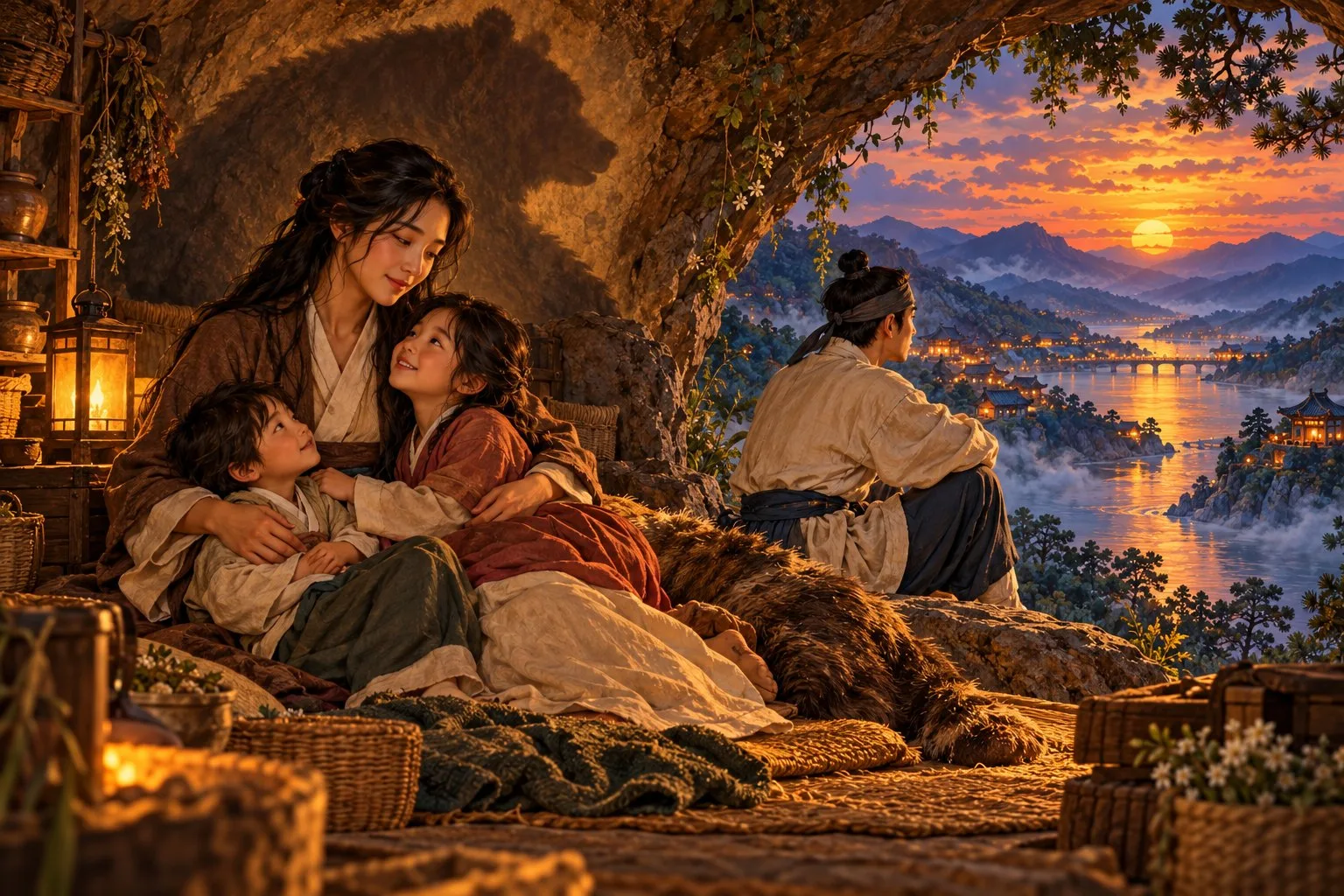
Slowly, the bear woman began to trust him. She stopped rolling the boulder across the cave. Sometimes she went down the mountain for a whole day to find food, and left him alone with the children, and every time she came back, he was still there.
But in his heart the young man had never stopped thinking of his village across the river. He thought of his mother and his friends. He thought of the smell of cooking fires and the sound of people talking. He thought of the ferry boats crossing back and forth in the evening light. And every time the bear woman went away, he walked a little further from the cave, and looked a little longer down the mountain toward the river.
At night, when the bear woman and the children were asleep, he would sit at the mouth of the cave and look down through the trees. On clear nights he could just make out a faint glow far below, across the river. He told himself it was the fires of his village, and he watched it until it went out.
The river crossing
One day, the bear woman set off early, going far into the hills. The children were playing at the back of the cave. The young man stood at the entrance, listening, until he could no longer hear her footsteps. Then he took a deep breath, and ran.
He ran down the mountain the way he had seen her come and go, crashing through the undergrowth, slipping on stones, his heart pounding. He did not stop until he burst out of the trees onto the riverbank. And there, by luck, a small boat was pulled up on the shingle. He shoved it into the water, jumped in and began to row for the far side as hard as he could.
He was halfway across when he heard it behind him: a terrible cry, half human and half animal, echoing off the mountain. The bear woman had come back and found the cave empty.
She came racing down the mountainside with the two children in her arms, and reached the shore just as he was in the middle of the river. She ran into the shallows until the water was up to her knees, and stood there calling to him.
She called his name. She held up the children, one in each arm, so that he could see them. The little ones were crying and reaching out toward their father. She begged him to come back. She called again, and again, and her voice broke.
The young man heard every word. But he kept on rowing, and he did not turn his head.
His arms ached and his eyes stung, but he made himself keep rowing, stroke after stroke, staring straight ahead at the far bank.
When she saw that he would not return, the bear woman gave one last long cry of grief that seemed to fill the whole valley. Then she held her two children close against her, walked out into the deep water, and the dark river closed over all three of them.
Bear Ferry
The young man reached the village at last, and his family wept with joy to see him alive. But he was never at peace again. All his life, people said, he could not look at that stretch of the river without remembering the voice calling him from the shore.

And from that day on, the people of the town called the crossing where it happened Gomnaru, Bear Ferry.
The capital of the bear
Bears are everywhere in Gongju’s history. When the kingdom of Baekje lost its first capital in 475, King Munju moved the court to this natural fortress beside the Geum River, and the new capital was called Ungjin, meaning “Bear Ferry”. The Encyclopedia of Korean Culture notes that Japanese records called it Kumanari and Chinese histories Goma, both versions of the same old word. In 1972, a stone bear statue was found near the ferry site, and a shrine was built where it stood.
Talk about it
Who do you feel more sorry for, the young man or the bear? Did the bear woman really love him, or only want to keep him? How is this bear different from the bear who became Ungnyeo in the story of Dangun?
Words to know
Gom (곰) means bear. Naru (나루) is a river ferry crossing. Ungjin (웅진) is the old name of Gongju, “Bear Ferry” in Chinese characters. Baekje (백제) was one of Korea’s Three Kingdoms, in the southwest of the peninsula.
Where this story comes from
This legend explains the name of Gomnaru, "Bear Ferry", a crossing on the Geum River at Gongju in South Chungcheong province. The Encyclopedia of Korean Culture records it in its entry on Gomnaru: a man of the area was taken by a she-bear from nearby Yeonmisan mountain, lived with her and had two children, and when he escaped, the bear drowned herself and her children in the river.
The name itself is very old. Gongju was once Ungjin, "Bear Ferry" written in Chinese characters, and it was the capital of the kingdom of Baekje for sixty-four years after the fall of its first capital in 475. Ancient Japanese and Chinese histories record the place as Kumanari and Goma. Today Gomnaru is a scenic site with a pine grove along the river, and in 1972 a stone statue of a bear was found there, around which a small shrine was built.
What it means
The Encyclopedia of Korean Culture places this story among tales of marriage between humans and animals, and points out that here, unusually, the animal plays the wife. Like the bear of the Dangun myth, the Gomnaru bear wants to join the human world, and like Dangun's mother, she bears human children. But this time the story ends in tragedy, because the man never truly accepts her.
The encyclopedia also suggests that the bear legends of Gongju show how sacred the bear once was in early Korean religion. The river crossing in the story helps the human and refuses the bear, separating the two worlds for good. It is a sad story, and many readers end up feeling more for the abandoned bear than for the man who ran.
Sources & further reading
Retold from the outline of the legend in the Encyclopedia of Korean Culture entries on Gomnaru and on tales of marriage between humans and animals. It is an English adaptation, not a translation.
- Encyclopedia of Korean Culture · 곰나루 (Gomnaru) ↗
- Encyclopedia of Korean Culture · 이류교혼설화 (tales of marriage between humans and other beings) ↗
Illustrations are imaginative interpretations, not historical records. Read our editorial policy.