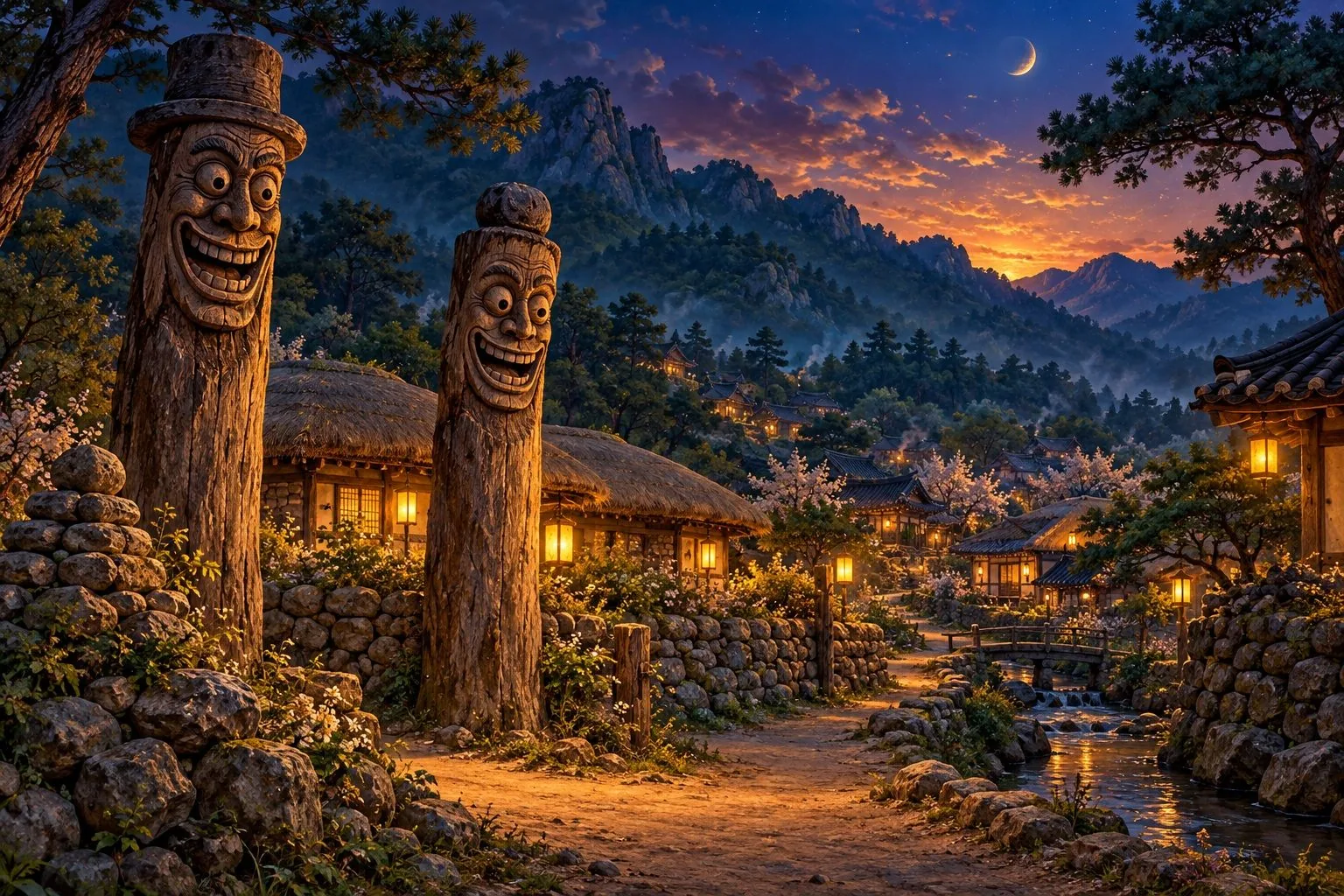
Walk into an old Korean village and the first residents to greet you might not be people. Standing on either side of the road, often in a pair, are two tall figures carved from tree trunks or stone. Their eyes bulge, their noses are round as fists, their mouths stretch from ear to ear, and some of them have fangs. Down the front of each one, in bold characters, runs a title: Cheonha Daejanggun, Great General Under Heaven, and Jiha Yeojanggun, Female General Under the Earth. These are jangseung (장승), the guardians of the Korean village, and they have been keeping watch at roadsides and village gates for more than a thousand years.
Gatekeepers, signposts and gods
The Encyclopedia of Korean Culture describes jangseung as sacred figures with human faces, carved from logs or stone and set up at village entrances and along roads. They do several jobs at once. They are the village’s gatekeepers and guardian gods, keeping out evil spirits and disease. They mark the borders of temple lands and the boundaries between districts. And some served as milestones: in the Joseon dynasty, roadside posts were set up every ten or thirty li with the distance and place names written on them, and these too came to be called jangseung.
They have many names. In the southern coastal provinces they are often beoksu. In Chungcheong they may be called susalmaegi, “the one who blocks evil”. On Jeju Island, the famous volcanic stone grandfathers, the dol hareubang, belong to the same family. The National Folk Museum of Korea counted over 540 jangseung sites in a 1999 survey, though some have since disappeared.
Generals of heaven and earth
Most jangseung stand in male and female pairs, facing each other across the road. The male usually wears an official’s hat, glares with wide eyes and bares crooked teeth beneath his whiskers, and his body may be painted red. The female has no hat, wears the red dots of a bride on her cheeks and forehead, and may be painted blue.
The inscriptions vary. Great General Under Heaven and Female General Under the Earth are the most common, but there are Daoist generals, generals of the four directions, such as the Blue General of the East and the White General of the West, Buddhist guardians with titles like “Ghosts Forbidden”, and jangseung put up specifically to keep smallpox away. Some faces are human, some are goblin-like monsters with bulging eyes and tusks, and some are gentle, smiling Buddha-like figures.
Where they came from
No one knows exactly how jangseung began. The encyclopedia lists several theories: that they grew from the boundary markers of temple lands, from older native sacred objects such as standing stones, bird poles and roadside cairns, or that they are related to similar traditions across northern Asia, the rice-growing south or the Pacific. Most scholars accept a mix of native and shared roots.
The earliest records go back to Silla and Goryeo, when stone boundary posts called jangsaeng marked temple estates. A stone marker at Tongdosa temple, dated 1085, still stands and is a national treasure. Famous stone jangseung of the Joseon period survive at Silsangsa temple in Namwon, carved in 1725, and in Buan, dated 1689. Wooden jangseung last only a few years in the wind and rain, so villages carved new ones regularly.
The jangseung festival
Setting up new jangseung was a village celebration. The encyclopedia describes the custom in Eommi-ri, a village in Gyeonggi province. Every two years, on the morning of the rite for the mountain god, the village men chose an alder tree, carved a new pair of jangseung and a sotdae, a tall pole topped with a carved bird, and set them up at the village entrance, the Great General Under Heaven on the road side and the General Under the Earth on the village side, their eyes meeting across the path. Then they held a rite.
What is striking is the contrast. The rite for the jangseung at the village gate was loud, cheerful and noisy, meant to drive bad luck and wandering spirits out of the village. At midnight, the village’s representative climbed the mountain behind the village to make offerings to the mountain god in solemn silence. The mountain god was the village’s high guardian, honoured quietly; the jangseung were the bouncers at the door.
Meet Sansin, the mountain god →
Fierce but friendly
Jangseung were sacred, and people did not touch them carelessly. A famous pansori tale tells of Byeon Gang-soe, a rough, idle man who chopped up a jangseung for firewood and died a horrible death as punishment. Yet the faces themselves are rarely truly frightening. The encyclopedia notes that the glaring eyes, fist-like nose and grin stretching to the ears look threatening at first, but also kind, and can seem goofy or even comical depending on who is looking. They are guardians with the soft heart of the ordinary people who carved them.
Koreans still joke about them. A tall, gangly person “looks like a nine-foot jangseung”, and someone standing about blankly is “standing there like a beoksu”. There are riddles too: what has a big mouth but cannot speak, has eyes but cannot see, and points the way day and night, in rain and snow?
Quick facts
Jangseung are carved wooden or stone guardian figures set up at Korean village entrances, temple boundaries and roadsides. Usually a male and female pair, inscribed “Great General Under Heaven” and “Female General Under the Earth”, they kept out evil spirits and disease and also served as boundary markers and milestones. Villages carved new wooden ones regularly with a noisy, cheerful rite, and their glaring, grinning faces are both fierce and friendly.